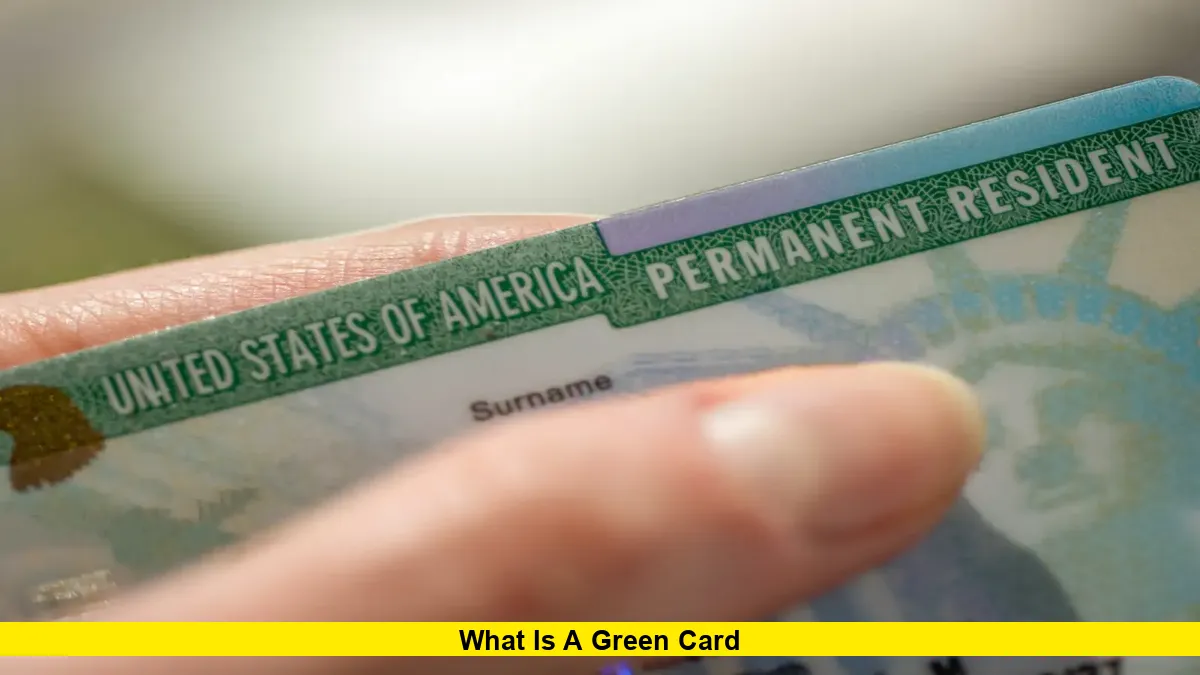
What is a green card is a common question for immigrants and families navigating the U.S. immigration system. A Green Card, officially called a Permanent Resident Card or Form I-551, is evidence that a person has lawful permanent resident status and is generally authorized to live and work permanently in the United States. As of September 1, 2026, the basic meaning of a Green Card remains unchanged, although current USCIS procedures and immigration requirements continue to evolve.
What Is a Green Card?
A Green Card is the physical identification card issued to a lawful permanent resident (LPR) of the United States. The federal government also refers to it as a Permanent Resident Card or Form I-551.
Having permanent resident status generally allows an individual to live permanently in the United States and work without needing a temporary employment visa. The card serves as important evidence of that immigration status.
USCIS explains that lawful permanent residents are people whom the U.S. government has authorized to live permanently in the country. Permanent residents receive a Permanent Resident Card as evidence of their identity and immigration status.
The term “Green Card” comes from the history of the document. Earlier versions had a green appearance, and the nickname continued even after the government introduced newer card designs and security features.
Today, the card is not necessarily bright green. However, “Green Card” remains the commonly used term for permanent resident status and the Permanent Resident Card.
What Does a Green Card Allow You to Do?
A Green Card provides major immigration benefits. Most importantly, lawful permanent residents can live permanently in the United States, subject to the rules governing maintenance of permanent residence.
Permanent residents are generally authorized to work in the United States without obtaining a separate employment authorization document simply because they hold permanent resident status.
The Green Card also provides evidence of status when dealing with government agencies, employers and other institutions. Federal law requires lawful permanent residents who are at least 18 years old to carry their Permanent Resident Card or other evidence of registration.
A Green Card does not, however, make someone a U.S. citizen.
Permanent residents remain noncitizens unless they later become citizens through naturalization or acquire citizenship through another applicable legal provision.
There are also important differences between permanent residents and U.S. citizens. For example, permanent residents generally cannot vote in federal elections. Citizenship provides additional rights and responsibilities that permanent resident status does not provide.
How Long Is a Green Card Valid?
For most lawful permanent residents, the physical Permanent Resident Card is generally issued with a 10-year validity period.
The expiration date on the card does not normally mean that the person’s underlying permanent resident status automatically ends on that date. Instead, eligible permanent residents generally use Form I-90, Application to Replace Permanent Resident Card, to renew or replace an expiring card.
USCIS identifies Form I-90 as the application used by lawful permanent residents and permanent residents in commuter status to replace or renew existing Permanent Resident Cards.
This distinction is important. A person should not assume that an expired physical card and loss of permanent resident status are the same thing.
Permanent residents should keep their documentation current and follow USCIS instructions when their card approaches expiration.
What Is a Conditional Green Card?
Not every permanent resident initially receives a 10-year card.
Some immigrants receive conditional permanent resident status. Conditional residents generally receive a card valid for two years.
This situation commonly applies to certain people who obtain permanent residence through marriage when the qualifying marriage is less than two years old at the time permanent residence is granted. Certain immigrant investors can also receive conditional permanent residence.
Conditional permanent residence requires an additional immigration filing.
A person who received conditional residence through marriage generally must file Form I-751, Petition to Remove Conditions on Residence, during the required filing period. Certain investor cases require Form I-829, Petition by Investor to Remove Conditions on Permanent Resident Status.
USCIS states that these petitions generally must be filed during the 90-day period immediately before the second anniversary of obtaining conditional permanent resident status.
This process is different from simply renewing a regular 10-year Green Card.
How Do People Get a Green Card?
There is no single Green Card application that applies to everyone.
Eligibility depends on the immigration category under which a person qualifies for permanent residence. Federal immigration law provides several pathways.
Common categories include:
- Family-based immigration
- Employment-based immigration
- Special immigrant categories
- Refugee and asylee adjustment
- Diversity Visa immigration
- Certain humanitarian and statutory programs
- Immigrant investor programs
The specific eligibility requirements depend on the category.
For example, some family-based immigrants qualify through a qualifying relationship with a U.S. citizen or lawful permanent resident. Employment-based immigrants may qualify through an employer-sponsored or other employment-related category.
The EB-5 immigrant investor program is another route. USCIS states that qualifying investors, spouses and unmarried children under 21 can seek lawful permanent residence through the program when they meet its investment and job-creation requirements.
Refugees and people granted asylum also have specific routes to permanent residence. USCIS states that refugees and asylees generally may apply for permanent residence after meeting the applicable one-year requirements.
Because eligibility varies substantially, having a qualifying relationship or employment opportunity does not automatically guarantee Green Card approval.
Adjustment of Status vs. Consular Processing
People who qualify for permanent residence may complete the immigration process in different ways.
One common process is adjustment of status. This generally allows an eligible person already in the United States to apply to become a lawful permanent resident without leaving the country for immigrant visa processing abroad.
Another route is consular processing. In that process, an immigrant visa applicant completes the required processing through a U.S. embassy or consulate abroad and becomes a permanent resident after entering the United States as an immigrant.
USCIS explains that lawful permanent residents generally receive their Permanent Resident Card after USCIS approves an adjustment application or after U.S. Customs and Border Protection admits the person into the United States as a permanent resident following consular processing.
For people entering with immigrant visas, USCIS says the immigrant fee is used to process the immigrant visa packet and produce the Permanent Resident Card. The agency advises paying the fee before traveling to the United States when possible.
Does a Green Card Expire?
The physical card usually has an expiration date, but that should not be confused with the concept of permanent residence itself.
For a regular permanent resident, the card is generally valid for 10 years. When the card expires or is approaching expiration, the resident generally files Form I-90 when eligible.
A conditional resident faces different rules because the person’s status itself is conditional. That person must follow the requirements for removing the conditions rather than simply treating the two-year card like a standard 10-year card.
A lost, stolen or damaged card can also require replacement.
USCIS’s current Form I-90 instructions specifically provide procedures for replacing a Permanent Resident Card that has been lost, stolen or destroyed and for other qualifying replacement situations.
Can a Green Card Holder Travel Outside the United States?
A Green Card generally allows a lawful permanent resident to travel internationally and seek to return to the United States, but permanent residents must be careful about extended periods outside the country.
Permanent residence is based on maintaining the United States as the person’s permanent home. Extended absences can create immigration problems and may affect future naturalization eligibility.
For naturalization purposes, USCIS generally considers an absence of one continuous year or more to break the required continuous residence period, although specific exceptions can apply. Absences of more than six months but less than one year can also require the applicant to establish that continuous residence was maintained.
People expecting to remain outside the United States for extended periods should review the immigration rules before traveling. A Green Card is not a guarantee that an individual can live abroad indefinitely while maintaining permanent resident status.
Can Green Card Holders Become U.S. Citizens?
Yes. Lawful permanent residence is commonly an important step toward U.S. citizenship through naturalization.
The general naturalization pathway usually requires a person to have been a lawful permanent resident for at least five years. Certain permanent residents married to and living with U.S. citizens may qualify under a three-year rule if they satisfy all applicable requirements.
Naturalization involves more than simply holding a Green Card for the required number of years.
Applicants generally must satisfy requirements involving continuous residence, physical presence, state or USCIS district residence, good moral character, English and civics knowledge, and other statutory requirements.
For the general five-year route, USCIS states that applicants generally must have been physically present in the United States for at least 30 months during the five-year period. Qualifying spouses of U.S. citizens generally use an 18-month physical-presence requirement during the three-year period.
A Current Change Green Card Holders Should Know About Citizenship Testing
One important current development concerns the naturalization civics test.
USCIS now uses the 2025 version of the naturalization civics test for applicants who are subject to that version. The updated test contains 128 possible civics questions.
For the standard 2025 test, the USCIS officer asks up to 20 questions, and an applicant must answer at least 12 correctly to pass.
The change matters to Green Card holders who are preparing to apply for naturalization.
It does not change the basic definition of permanent residence. Instead, it affects the citizenship process that eligible permanent residents may pursue later.
USCIS also notes that some civics answers can change because of elections or appointments. Applicants should therefore use the agency’s current citizenship-test updates when preparing for an interview.
What a Green Card Does Not Mean
A Green Card is an important immigration status, but it is not the same as citizenship.
A lawful permanent resident generally cannot:
- Vote in federal elections.
- Use a Green Card as proof of U.S. citizenship.
- Assume that permanent residence can be maintained while permanently living outside the United States.
- Ignore immigration requirements simply because the physical card has not yet expired.
Permanent residents also remain subject to U.S. immigration laws. Certain criminal conduct, immigration violations and other circumstances can create serious consequences for permanent resident status.
The physical card should therefore be viewed as evidence of a broader legal status rather than as a document that independently grants unlimited rights.
Green Card vs. U.S. Citizenship
The distinction is straightforward but important.
| Green Card Holder | U.S. Citizen |
|---|---|
| Lawful permanent resident | U.S. citizen |
| Generally authorized to live permanently in the U.S. | U.S. citizen with constitutional and statutory citizenship rights |
| Generally authorized to work | Authorized to work |
| Generally cannot vote in federal elections | Can vote in federal elections if otherwise eligible |
| Must maintain permanent resident status | Citizenship is not maintained through Green Card renewal |
| May qualify for naturalization | Already a citizen |
| Usually carries a Permanent Resident Card | Uses U.S. citizenship documents such as a passport |
The difference becomes particularly important when someone is considering international travel, naturalization or a long-term move outside the United States.
What Is the Most Important Thing to Remember About a Green Card?
A Green Card is evidence of lawful permanent resident status in the United States. It generally gives an eligible immigrant the ability to live and work permanently in the country while requiring the person to follow U.S. immigration laws.
The card itself normally has a 10-year validity period for regular permanent residents. Conditional residents have different two-year requirements and must take additional steps to remove the conditions.
Current USCIS information also confirms that Green Card holders remain a major part of the naturalization pathway. Eligible permanent residents can eventually apply for U.S. citizenship when they meet the applicable requirements, including the relevant residence, physical-presence and testing rules.
For anyone researching what is a green card, the simplest answer is that it is the commonly used name for the Permanent Resident Card issued to lawful permanent residents. It represents one of the most significant immigration statuses available under U.S. law, while remaining distinct from citizenship.
Green Card rules and immigration procedures can change, so readers should check the latest USCIS requirements before filing an application or making an important immigration decision.
2 thoughts on “What Is a Green Card? A Current Guide to U.S. Permanent Residence”