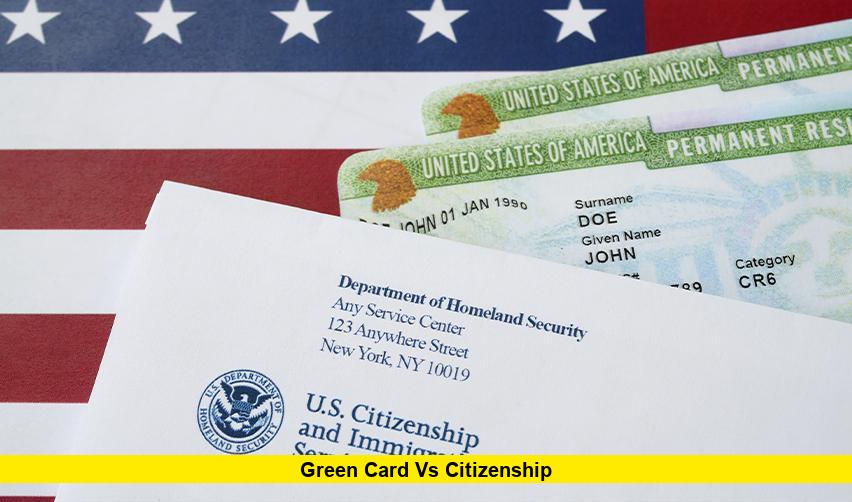
Choosing between a Green Card and U.S. citizenship is an important decision for immigrants building a permanent future in America. Understanding Green Card vs Citizenship means looking beyond the right to live and work in the United States. The two statuses differ in voting rights, international travel, family immigration benefits, protection against deportation, government employment opportunities, and long-term security.
A Green Card gives an eligible immigrant lawful permanent resident status, allowing them to live and work permanently in the United States while remaining a citizen of another country. U.S. citizenship provides a broader set of rights and responsibilities, including voting in federal elections, applying for an American passport, and qualifying for certain public offices. For many permanent residents, naturalization represents the next step toward a more secure legal and civic connection to the country.
If you are deciding which status best fits your future, examine how each option affects your family, career, travel plans, and long-term goals. Understanding these differences can help you make a more informed decision about whether to maintain permanent residence or pursue naturalization when eligible.
What Is a Green Card?
A Green Card, officially called a Permanent Resident Card, is proof that a person has lawful permanent resident status in the United States. It allows the holder to live in the country indefinitely, subject to immigration law, and work for most employers without needing a separate employment authorization document.
Green Card holders are also known as lawful permanent residents, or LPRs. They can rent or buy homes, attend school, establish businesses, open bank accounts, and participate in everyday American life. They generally have access to many of the same private-sector opportunities available to citizens, although certain jobs and government benefits have additional eligibility requirements.
Permanent residence does not automatically make someone an American citizen. A Green Card holder generally retains the citizenship and passport of their country of origin unless they separately acquire another nationality.
The card itself also has an expiration date in many cases. An expiring card does not necessarily mean permanent resident status has ended, but holders must follow the applicable renewal or replacement procedures and maintain evidence of their status.
Some Green Cards are issued with conditions, including certain cards granted through marriage or investment. Conditional residents must take the required steps to remove those conditions rather than assume the card can simply be renewed in the ordinary way.
The central point: A Green Card establishes permanent resident status, but it does not provide every right associated with U.S. citizenship.
What Is U.S. Citizenship?
U.S. citizenship establishes a person’s legal membership in the United States. People can become citizens through birth under applicable citizenship laws or through naturalization if they meet the relevant requirements.
Naturalization is the process through which an eligible noncitizen becomes a U.S. citizen. For many immigrants, the process begins after obtaining a Green Card and maintaining permanent residence for the required period.
Citizenship carries significant political and legal rights. Eligible citizens can vote in federal elections, apply for a U.S. passport, serve on juries when required, and seek federal elected offices when they satisfy the relevant constitutional qualifications.
Citizens also generally have stronger protection against removal from the United States than permanent residents. Citizenship is not ordinarily lost because someone spends an extended period abroad, although specific legal circumstances can affect citizenship status.
Becoming a citizen also involves responsibilities. Applicants generally must demonstrate the required knowledge of English and U.S. civics, establish good moral character, satisfy residence and physical-presence requirements, and take the Oath of Allegiance unless a specific exception applies.
A person does not become a citizen merely because a naturalization application is approved. In the standard naturalization process, citizenship takes effect when the applicant completes the required oath ceremony, subject to applicable law.
For immigrants who want a lasting connection to America, citizenship can provide a level of legal security and civic participation that permanent residence does not.
Green Card vs Citizenship: The Biggest Differences at a Glance
The distinction becomes clearer when the two statuses are compared across everyday rights and long-term opportunities.
| Feature | Green Card holder | U.S. citizen |
|---|---|---|
| Live permanently in the U.S. | Yes, subject to immigration law | Yes, subject to limited legal exceptions |
| Work for most private employers | Generally yes | Generally yes |
| Vote in federal elections | No | Yes, if otherwise eligible |
| Apply for a U.S. passport | No, based on permanent residence alone | Yes |
| Face immigration removal proceedings | Yes, under applicable grounds | Generally not subject to ordinary deportation as a noncitizen |
| Sponsor certain family members | Yes, within narrower categories | Yes, with broader family-based options |
| Remain abroad indefinitely without affecting status | Not guaranteed | Generally yes |
| Qualify for citizenship-based federal jobs | Not ordinarily, unless an exception applies | May qualify, subject to job requirements |
| Serve on a federal jury | Generally not eligible | Generally eligible when qualified |
| Run for president | No | Must meet constitutional citizenship requirements |
| Renew an immigration status card | Usually required when applicable | No Green Card renewal |
| Maintain original nationality | Generally yes | Depends on the laws of both countries and the person’s circumstances |
These differences do not mean that Green Card holders lack meaningful rights. Permanent residents have important legal protections and can build stable lives in the United States. However, citizenship removes many of the immigration-related limitations that remain attached to permanent residence.
The best choice depends on your priorities, eligibility, personal circumstances, and whether you want the full legal and civic rights of an American citizen.
Voting Rights: One of the Clearest Differences
Voting is among the most important distinctions between permanent residence and citizenship.
U.S. citizens who satisfy the applicable age, registration, residency, and other requirements can vote in federal elections. They can participate in presidential elections, congressional races, and other contests for which they are eligible.
Green Card holders cannot vote in federal elections. They also generally cannot vote in state elections, and most local elections restrict voting to citizens. A small number of local jurisdictions have adopted limited rules allowing certain noncitizens to vote in particular municipal elections, but these exceptions do not provide a general right to vote as a permanent resident.
Permanent residents should never assume that possessing a Green Card gives them the right to register or vote in an election. Voting eligibility must be checked carefully, especially when completing voter registration paperwork.
False claims of U.S. citizenship can create serious immigration consequences. A permanent resident who mistakenly or deliberately represents themselves as a citizen to register or vote may jeopardize future immigration benefits and could face additional legal problems.
Why this matters: Citizenship gives eligible immigrants a direct role in choosing the nation’s political leadership. A Green Card allows lawful residence and participation in many aspects of community life, but it does not ordinarily include the right to vote.
For someone who wants to influence federal policy through elections, naturalization can be a significant milestone.
Travel and Passports: Which Status Offers More Freedom?
International travel can look very different for permanent residents and citizens.
A Green Card holder generally travels using a valid passport issued by their country of citizenship, along with their Green Card and any other documents required for the journey. The Green Card helps establish the right to return to the United States as a permanent resident, but it does not replace a national passport.
A U.S. citizen can apply for an American passport and use it for international travel. The passport serves as evidence of U.S. citizenship and can facilitate access to American consular assistance abroad.
The differences become especially important during long trips.
Permanent residents must maintain the United States as their permanent home. Extended absences can raise questions about whether they have abandoned permanent residence, depending on the duration of the trip, their intentions, their ties to the country, and other facts.
There is no universal rule that every trip shorter than six months is automatically safe or that every trip longer than a year automatically ends permanent residence. Immigration consequences depend on the applicable rules and the individual circumstances.
A reentry permit may help certain permanent residents who expect to travel abroad for an extended period, but it does not guarantee admission or eliminate every immigration concern. A reentry permit also does not automatically preserve continuous residence for naturalization purposes.
U.S. citizens generally do not face the same permanent-residence abandonment issue simply because they live abroad for an extended period. They must still comply with passport rules, foreign-country entry requirements, and other applicable laws.
For example, imagine a permanent resident who accepts a two-year assignment overseas. The individual should assess how the assignment could affect permanent residence and future naturalization eligibility before leaving. A citizen accepting the same assignment generally does not need to preserve Green Card status, although tax obligations and other legal responsibilities may continue.
Travel plans should therefore be part of the decision about whether to pursue citizenship.
Protection Against Deportation and Immigration Removal
The security of a person’s immigration status is another major difference.
A Green Card gives its holder the right to reside permanently in the United States, but that status can be placed at risk under certain circumstances. Grounds for removal can include specified criminal convictions, immigration fraud, certain security-related issues, and other violations defined by law.
Permanent residents have legal rights in removal proceedings and may have defenses or relief available depending on their individual circumstances. A criminal conviction does not produce identical consequences in every case; the offense, sentence, immigration history, and relevant legal provisions can all matter.
Citizens generally have much stronger protection from deportation because they are not subject to ordinary removal proceedings as noncitizens. Naturalized citizens ordinarily retain citizenship unless it is lawfully revoked through a legally applicable process.
Denaturalization is not the same as ordinary deportation. It can arise in limited circumstances, such as when citizenship was illegally procured or obtained through material concealment or misrepresentation. The government must follow the applicable legal procedures.
This distinction is particularly important for permanent residents with complicated immigration histories or potential criminal-law issues.
A Green Card should not be treated as a guarantee that immigration status can never be challenged. Similarly, citizenship should not be viewed as completely immune from legal scrutiny in every conceivable circumstance.
Anyone with a criminal record, a prior removal order, possible immigration misrepresentation, or uncertainty about how they obtained permanent residence should obtain individualized legal advice before applying for naturalization or making major travel decisions.
The broader lesson is that citizenship generally provides a more secure status, but eligibility and legal history matter at every stage.
Who Can Apply for U.S. Citizenship?
Many Green Card holders become eligible for naturalization after maintaining permanent residence for a specified period. However, simply possessing a Green Card for a certain number of years does not automatically qualify someone for citizenship.
For the standard naturalization route, applicants generally must meet requirements that include the following:
- Be at least 18 years old when filing.
- Have been lawfully admitted as a permanent resident.
- Meet the applicable continuous-residence requirement.
- Satisfy the required physical presence in the United States.
- Have lived for the required period in the state or USCIS district with jurisdiction over their residence.
- Demonstrate good moral character during the applicable period.
- Meet the English-language requirement unless exempt.
- Demonstrate knowledge of U.S. history and government unless exempt.
- Show attachment to the principles of the U.S. Constitution and the required disposition toward the good order and happiness of the United States.
- Take the Oath of Allegiance, unless a lawful exception applies.
The familiar five-year rule applies to many permanent residents. Under the general rule, an applicant usually must have held permanent residence for five years before naturalization, while also meeting continuous-residence and physical-presence requirements.
Certain applicants married to U.S. citizens may qualify under a three-year naturalization provision if they meet additional conditions. Marriage to a citizen does not automatically confer citizenship or guarantee eligibility under this shorter route.
Some military service members and other qualifying applicants may be covered by special naturalization provisions. The applicable requirements depend on the person’s circumstances and the specific legal provision involved.
Applicants should also understand that the date they received permanent residence matters. Time spent in the United States on a temporary visa before obtaining a Green Card generally does not count toward the standard five-year permanent-resident period.
Eligibility can also be affected by extended absences, criminal history, unpaid taxes in certain circumstances, failure to meet support obligations where applicable, false claims to citizenship, and other issues.
Before filing, applicants should review their immigration records and calculate their eligibility carefully. Filing too early or overlooking an important issue can delay the process or lead to a denial.
The Naturalization Process: From Green Card to Citizenship
Naturalization requires more than completing an application. Applicants must demonstrate that they meet the legal requirements, provide accurate information, complete the required examination steps, and take the Oath of Allegiance.
The process generally involves the following stages.
Step 1: Check your eligibility
Begin by reviewing your permanent-resident start date, travel history, physical presence, criminal history, tax compliance, and other relevant circumstances. Make sure you qualify under the correct naturalization category.
Many applicants use the five-year permanent-residence route. Others may qualify under the three-year provision for certain spouses of U.S. citizens or under special provisions for military service members.
Step 2: Complete Form N-400
Form N-400 is the Application for Naturalization. Applicants must answer questions about their identity, immigration history, residence, employment, family, travel, and other matters relevant to eligibility.
Accuracy is essential. Omissions, inconsistencies, or incorrect answers can lead to additional questions, delays, or a denial. Applicants should review their records before submitting the form.
Step 3: Complete biometrics requirements, if applicable
U.S. Citizenship and Immigration Services may require fingerprints, a photograph, or a signature as part of the process. The agency may also reuse previously collected biometrics when permitted.
Applicants should follow the instructions in their appointment notices and respond promptly to any additional requests.
Step 4: Attend the naturalization interview
During the interview, an officer reviews the application and asks questions about the applicant’s background and eligibility. Applicants generally must complete the required English and civics examinations unless they qualify for an exception or waiver.
The officer may request additional documentation or clarification before making a decision.
Step 5: Complete the Oath of Allegiance
After approval, the applicant generally receives instructions for a naturalization ceremony. In the standard process, the applicant becomes a U.S. citizen after completing the required Oath of Allegiance.
The citizenship certificate provides evidence of naturalization and can be used when applying for a U.S. passport or completing other procedures that require proof of citizenship.
Processing times vary by office, application volume, case complexity, and other factors. Applicants should avoid relying on a single estimated timeline when making important travel, employment, or family plans.
What Is the Naturalization Test, and What Has Changed?
The naturalization examination is an important part of the citizenship process. Applicants generally must demonstrate the required knowledge of English and U.S. government and history, subject to applicable exemptions.
The English requirement normally includes speaking, reading, and writing. During the interview, the officer evaluates the applicant’s ability to communicate in English and may administer the reading and writing portions.
The civics portion tests knowledge of American history, government, constitutional principles, and the country’s political system.
The applicable civics test depends on when the applicant filed Form N-400. USCIS introduced a 2025 naturalization civics test for applicants filing on or after October 20, 2025. Applicants who filed before that date generally remain subject to the earlier 2008 civics test, subject to the applicable transition rules.
Under the 2025 test, the question bank contains 128 possible civics questions, and the officer asks up to 20 questions. Applicants generally must answer at least 12 correctly to pass.
The 2008 test uses a different format, with up to 10 questions selected from a bank of 100, and applicants generally must answer at least six correctly.
Applicants should prepare using the official study materials applicable to their filing date rather than relying on older online quizzes without checking which test they need.
Some applicants qualify for exceptions to the English requirement based on age and length of permanent residence. Certain applicants with qualifying medical conditions may also seek an exception to English and civics testing through the applicable procedures.
A testing exemption does not necessarily remove every other naturalization requirement. Applicants must still satisfy the requirements that apply to their case.
The practical lesson is straightforward: check the current testing rules before studying, because preparing for the wrong test can waste time and create unnecessary stress.
Family Sponsorship: Which Status Provides More Options?
Family immigration is another area where citizenship can make a significant difference.
Green Card holders can generally petition for certain family members, including eligible spouses and unmarried children. However, permanent residents cannot sponsor every category of relative available to U.S. citizens.
U.S. citizens have broader family-sponsorship options. Depending on the circumstances, they may petition for spouses, unmarried and married children, parents, and siblings.
The eligibility requirements differ by relationship. For example, a U.S. citizen generally must be at least 21 years old to petition for a parent or sibling under the applicable family-based immigration categories.
Citizens also have access to immediate-relative immigration categories for qualifying spouses, unmarried children under 21, and parents of adult citizens. These categories are not subject to the same annual numerical limits as family-preference categories, although application processing and other requirements still apply.
Green Card holders’ family petitions generally fall within the family-preference system, where annual limits and priority dates can affect waiting times.
This can make a substantial difference for families separated by international borders.
Imagine a permanent resident who wants to help an adult married child immigrate to the United States. Permanent residents cannot petition for married sons or daughters under the family-preference categories. If that permanent resident later becomes a U.S. citizen, the person may be able to file a petition under the category for married sons and daughters of citizens, subject to the applicable rules and waiting periods.
Naturalization does not mean that every relative will receive immediate permission to immigrate. Family petitions still require supporting documentation, eligibility checks, and completion of the relevant immigration process.
Nevertheless, citizenship can expand the range of family relationships for which a person may petition.
Employment Opportunities and Government Jobs
Both Green Card holders and U.S. citizens can pursue a wide range of employment opportunities in America.
Permanent residents generally have broad authorization to work for private employers without requiring an employer-sponsored work visa. They can change employers, pursue professional qualifications, start businesses, and seek promotions, subject to any separate licensing or occupational rules.
Citizens also enjoy broad employment rights, but their citizenship provides access to certain positions that require U.S. nationality.
Some federal government jobs require citizenship, and many positions involving national security clearances have citizenship requirements. Specific eligibility rules depend on the agency, role, clearance level, and applicable law.
A Green Card holder may qualify for some public-sector positions or government-related work, but should not assume that every federal job is open to permanent residents.
Citizenship can also matter in occupations involving elected office or statutory responsibilities reserved for citizens.
For people working in science, technology, defense, public administration, or other fields connected to government contracts, citizenship may expand career options. However, it does not guarantee employment, a security clearance, or eligibility for every restricted position.
Private-sector employers may impose their own lawful requirements, and some jobs require professional licenses or background checks regardless of immigration status.
Before making a citizenship decision for career reasons, applicants should examine the actual eligibility rules for the positions they want rather than assuming that citizenship is necessary for every well-paid or specialized job.
Federal Benefits, Social Security, and Public Assistance
The relationship between immigration status and government benefits is more complicated than a simple citizen-versus-resident comparison.
Green Card holders may qualify for Social Security retirement benefits, disability benefits, Medicare, or other programs if they meet the relevant requirements. Eligibility may depend on work history, earnings, age, disability status, residency, immigration category, and other factors.
U.S. citizenship does not automatically qualify someone for every benefit. Citizens must still satisfy program-specific requirements.
Some public benefits have immigration-related eligibility restrictions. Certain programs may require a qualifying immigration status, a minimum period of residence, sufficient work credits, or other conditions. State-administered programs can also have different rules.
For Social Security retirement benefits, for example, eligibility generally depends on age and the necessary work credits, although other eligibility pathways exist. A Green Card holder who meets the applicable rules may receive benefits without first becoming a citizen.
Medicare eligibility also depends on specific conditions, including age or qualifying disability, work history, and other statutory rules. Lawful permanent residence alone does not guarantee immediate eligibility for every part of Medicare.
Naturalization can remove certain immigration-status barriers, but it does not replace the need to meet the individual program’s requirements.
Applicants should therefore avoid making a citizenship decision based solely on assumptions about benefit eligibility. The relevant agency’s rules and the person’s work and residence history matter.
Taxes: Are Green Card Holders and Citizens Treated Differently?
Taxes are an important consideration for both permanent residents and citizens.
For U.S. federal income tax purposes, lawful permanent residents are generally treated as resident aliens under the Green Card test. They are generally subject to U.S. income tax on worldwide income, much like U.S. citizens.
This can include income earned from employment, investments, rental properties, and other sources, subject to applicable tax rules, exclusions, deductions, and treaty provisions.
A Green Card holder living overseas may still have U.S. tax filing obligations. Moving abroad does not automatically end U.S. tax residency for federal tax purposes while permanent resident status remains in effect.
U.S. citizens generally remain subject to U.S. tax rules on worldwide income even when living outside the country, although foreign tax credits, exclusions, and other provisions may reduce double taxation in qualifying circumstances.
The tax consequences of ending permanent residence can be complex. Surrendering a Green Card or otherwise ending lawful permanent resident status does not necessarily eliminate every tax obligation, and special rules may apply to certain long-term residents.
State tax residency can create separate issues. Someone who moves abroad or to another state may need to examine domicile, income sources, and the relevant state’s rules.
Before naturalization, immigrants with overseas income, foreign businesses, substantial assets, or complicated tax histories should review their circumstances with a qualified tax professional.
Citizenship is not a universal tax-saving strategy. In many ordinary situations, Green Card holders and citizens face similar federal income tax obligations.
Dual Citizenship: Can You Keep Your Original Nationality?
Many immigrants want to become U.S. citizens without giving up their original nationality.
The United States generally permits dual nationality. This means a person may be a citizen of the United States and another country at the same time, depending on the laws and circumstances involved.
However, the United States cannot guarantee that another country will recognize or permit dual citizenship. Some countries restrict dual nationality or impose conditions that may affect a person’s status after naturalization elsewhere.
A country may require a citizen to renounce their original nationality, notify authorities of a new citizenship, or satisfy other legal requirements. The consequences depend on that country’s law.
Dual nationals may also face practical issues involving passports, consular assistance, military obligations, taxation, or entry and exit rules.
For example, someone who becomes a U.S. citizen may be allowed to retain another nationality under U.S. law, while the person’s country of origin may apply a different rule. The individual should establish the consequences before taking the oath.
People who maintain dual nationality should also understand that the United States may expect them to use a U.S. passport when entering or leaving the country, subject to applicable rules.
Naturalization does not automatically require every immigrant to abandon their previous cultural identity or nationality. The key is determining how the laws of both countries apply.
The Cost of Citizenship: Application Fees and Other Expenses
Applying for naturalization involves costs that permanent residents do not necessarily face if they decide to keep their current status.
The primary government application is Form N-400. The applicable filing fee depends on the current fee schedule and the method of filing. Certain eligible applicants may qualify for a reduced fee or fee waiver.
Applicants should check the current USCIS fee schedule before submitting an application because fees and payment procedures can change.
Additional expenses may include transportation to appointments, document replacement, obtaining records, and professional legal assistance when needed.
An attorney is not required for every naturalization application. Applicants with straightforward cases may be able to prepare their applications independently using official instructions. However, legal assistance can be particularly valuable when a case involves criminal convictions, extended international absences, prior immigration violations, disputed eligibility, or other complications.
The financial decision should account for more than the application fee. Consider the potential value of voting rights, expanded family sponsorship, access to citizenship-restricted jobs, and greater protection against removal.
At the same time, applicants should not feel compelled to apply before they are eligible or financially prepared. Maintaining permanent residence is a legitimate option for those who continue to meet their obligations and prefer not to naturalize.
What Responsibilities Come With Each Status?
Permanent residents and citizens both have responsibilities, although the nature of those responsibilities differs.
Green Card holders must comply with U.S. laws, file taxes when required, maintain their permanent-residence obligations, and keep immigration records and documents in order. They should notify the appropriate authorities of address changes when required.
Permanent residents should also understand that serious criminal conduct, immigration fraud, or abandonment of residence can jeopardize their status.
U.S. citizens must comply with federal, state, and local laws and meet applicable tax obligations. They may be called for jury service, and citizens who meet the requirements for jury duty generally must respond to summonses.
Citizens also have the right to vote, although voting is not mandatory in federal elections. Participating in elections is one way citizens exercise their political rights.
The naturalization oath includes commitments associated with allegiance to the United States. Certain applicants may have additional considerations involving military service or other legal obligations.
Citizenship also carries a civic dimension. Citizens can participate in democratic institutions, engage with elected representatives, and seek certain public offices when eligible.
Neither status removes the need to understand and follow the law. The main difference is that citizenship brings additional political rights and a more secure legal relationship with the country.
Can a Green Card Holder Lose Permanent Residence?
Permanent residence is intended to be ongoing, but it is not unconditional.
A person may encounter immigration problems if authorities determine that a legal ground for removal applies. Examples can include certain criminal offenses, fraud connected to obtaining immigration benefits, or other violations of immigration law.
Permanent residents can also face questions about whether they have abandoned their U.S. residence after living abroad for an extended period.
Abandonment is not determined solely by counting the number of days outside the country. Authorities may consider the length and purpose of the trip, whether the person maintained a home in the United States, employment and family connections, tax filings, and other evidence.
A reentry permit may help demonstrate that an extended absence was planned, but it does not guarantee that the person will be admitted or that continuous residence for naturalization will remain intact.
Conditional permanent residents must also follow the requirements for removing conditions on their status.
If a Green Card holder is placed in removal proceedings, they may have legal defenses or other forms of relief available, depending on the facts and law. The appropriate strategy should be based on an individual legal assessment.
Citizenship generally provides substantially stronger protection against ordinary immigration removal. However, citizenship obtained through unlawful means or material misrepresentation may be subject to denaturalization proceedings under applicable law.
Maintaining accurate records and seeking legal advice when problems arise can help immigrants protect their rights.
Does Becoming a Citizen Affect Your Children?
Naturalization can have important consequences for children, but the outcome depends on their age, immigration status, residence, and relationship to the parent.
Certain children born outside the United States may automatically acquire U.S. citizenship when their U.S. citizen parent and the child satisfy the requirements established by law.
For children who immigrate to the United States as permanent residents, automatic acquisition of citizenship may occur when specific conditions are met. Under the general rule for qualifying children under 18, the child must have at least one U.S. citizen parent, hold lawful permanent resident status, and reside in the United States in that parent’s legal and physical custody.
Not every child of a naturalizing parent automatically becomes a citizen. The applicable requirements must be assessed individually.
For example, an unmarried child under 18 who is a Green Card holder and lives in the United States in the legal and physical custody of a parent who naturalizes may acquire citizenship automatically if all statutory conditions are met.
A child who is already 18 or older generally does not automatically acquire citizenship simply because a parent naturalizes. That person may need to qualify independently or may already have citizenship under a different provision.
Parents should also understand that a child’s eligibility for a passport or citizenship certificate may require documentation of the relevant facts.
If a family includes children approaching age 18, reviewing the rules early can help avoid confusion about whether citizenship was acquired automatically or requires a separate application.
Real-World Example: Choosing the Right Time to Naturalize
Consider Maria, who obtained a Green Card through an employment-based immigration category. She has lived in the United States for several years, works for a private company, pays her taxes, and visits relatives overseas every year.
For Maria, permanent residence provides many of the benefits she needs. She can work, rent a home, travel internationally using her passport and Green Card, and build a long-term career.
However, she is considering a promotion at a federal agency that requires U.S. citizenship. She also wants to vote in upcoming elections and petition for a family member who is not eligible under the family categories available to permanent residents.
These priorities may make naturalization attractive, provided she meets the requirements.
Before applying, Maria would need to examine her permanent-resident start date, travel history, physical presence, continuous residence, and other eligibility factors. She would also need to prepare for the applicable naturalization examination and budget for the application.
Now consider David, who has permanent residence but expects to spend several years working overseas. He wants to retain his Green Card and eventually become a citizen.
David should not assume that his years as a permanent resident will automatically count toward naturalization regardless of how much time he spends abroad. He needs to understand the effects of his travel plans on both permanent residence and continuous residence.
The two examples illustrate an important principle: the best choice depends on an immigrant’s goals, not simply on how long the person has lived in America.
For one individual, naturalization may open valuable professional and family opportunities. For another, the immediate priority may be preserving permanent residence while carefully managing international travel.
Common Misunderstandings About Green Cards and Citizenship
Several misconceptions can cause confusion when immigrants compare the two statuses.
Misunderstanding 1: A Green Card holder can vote because they pay taxes.
Paying taxes does not create voting eligibility. Permanent residents generally cannot vote in federal elections, even when they have lived in the United States for decades.
Misunderstanding 2: Every Green Card holder becomes a citizen after five years.
Naturalization is not automatic. Eligible applicants must submit the required application, meet all applicable requirements, and complete the process.
Misunderstanding 3: A Green Card is the same as a U.S. passport.
A Green Card documents permanent resident status. A U.S. passport is available to U.S. citizens and serves as evidence of nationality for international travel.
Misunderstanding 4: A permanent resident can live abroad indefinitely without consequences.
Extended absences can affect permanent residence and future naturalization eligibility. A person’s travel history and intentions matter.
Misunderstanding 5: Marriage to a U.S. citizen automatically grants citizenship.
Marriage does not automatically confer citizenship. Certain spouses may qualify for a shorter naturalization period, but they must satisfy the applicable requirements.
Misunderstanding 6: Becoming a citizen automatically makes every family member eligible to immigrate.
Family sponsorship rules depend on the relationship, the petition category, and other legal requirements. Some relatives may still face substantial waiting periods.
Misunderstanding 7: Citizenship eliminates every possible legal risk.
Citizens generally have strong protection against deportation, but citizenship obtained illegally or through material misrepresentation may be subject to denaturalization proceedings under the law.
Misunderstanding 8: Everyone must pass the same naturalization test.
The applicable examination can depend on the filing date and whether an applicant qualifies for a legal exception or accommodation.
Understanding these distinctions can help applicants avoid expensive mistakes and make decisions based on the actual law.
Which Is Better for You: A Green Card or U.S. Citizenship?
Neither status is automatically the best choice for every immigrant. The right decision depends on personal goals, eligibility, family needs, travel plans, and long-term priorities.
A Green Card may meet your needs if:
- You want to live and work permanently in the United States.
- You are not yet eligible for naturalization.
- You prefer to retain your current immigration status while evaluating your options.
- You can maintain permanent residence and comply with its requirements.
- You do not currently need citizenship-specific rights or opportunities.
Citizenship may be more suitable if:
- You want to vote in federal elections.
- You want to apply for a U.S. passport.
- You seek stronger protection against ordinary deportation.
- You want broader family-based immigration sponsorship options.
- You are pursuing employment opportunities restricted to citizens.
- You want to reduce the immigration-status concerns associated with extended residence abroad.
These considerations should be weighed against the cost, preparation, and legal requirements involved in naturalization.
Applicants with complicated travel histories, criminal records, tax issues, or uncertainty about their eligibility should seek qualified legal advice before filing.
For immigrants who qualify and want the full rights of citizenship, naturalization can be an important step toward a more secure future. For those who are not ready or do not qualify, maintaining lawful permanent residence remains a valuable status.
How to Prepare for a Citizenship Decision
A practical decision begins with an honest assessment of your circumstances.
First, establish your permanent-resident start date and identify the naturalization category that may apply to you. Next, calculate your time in the United States and review international trips that could affect continuous residence or physical presence.
Then examine your legal and financial records. Consider whether you have any unresolved tax issues, criminal matters, past immigration inconsistencies, or other circumstances that require professional review.
Think about your future plans as well. If you intend to pursue citizenship-restricted employment, sponsor additional family members, or travel abroad for extended periods, these goals may influence your decision.
Prepare for the applicable naturalization test if you qualify to apply. Use study materials that match your filing date and seek accommodations or exemptions when you meet the legal requirements.
Finally, review the current application instructions, filing fee, and supporting-document requirements before submitting Form N-400.
Do not rush the process simply because you have reached a familiar anniversary date. Eligibility depends on all applicable requirements, not just the number of years shown on a Green Card.
A careful review can help you determine whether to apply now, wait until you qualify, or seek legal guidance before taking the next step.
Final Thoughts on Green Card vs Citizenship
The difference between permanent residence and citizenship extends well beyond the documents a person carries. A Green Card allows immigrants to establish lasting lives in the United States, work for most employers, and enjoy many important legal protections. U.S. citizenship adds voting rights, access to an American passport, broader family sponsorship options, and stronger protection against ordinary immigration removal.
For many immigrants, the decision becomes clearer when they consider their priorities. Someone who values political participation, expanded family opportunities, and long-term security may find naturalization especially worthwhile. Someone who has not yet qualified or needs to evaluate personal circumstances may choose to maintain permanent residence while preparing for the future.
The most important step is to understand the requirements and make an informed decision based on your own circumstances. Immigration rules can change, so applicants should review current government guidance before filing or making significant travel plans.
Are you planning to keep your Green Card or pursue U.S. citizenship? Share your perspective in the comments and stay informed about important immigration updates.
2 thoughts on “Green Card vs Citizenship: 12 Major Differences Every Immigrant in America Should Understand”