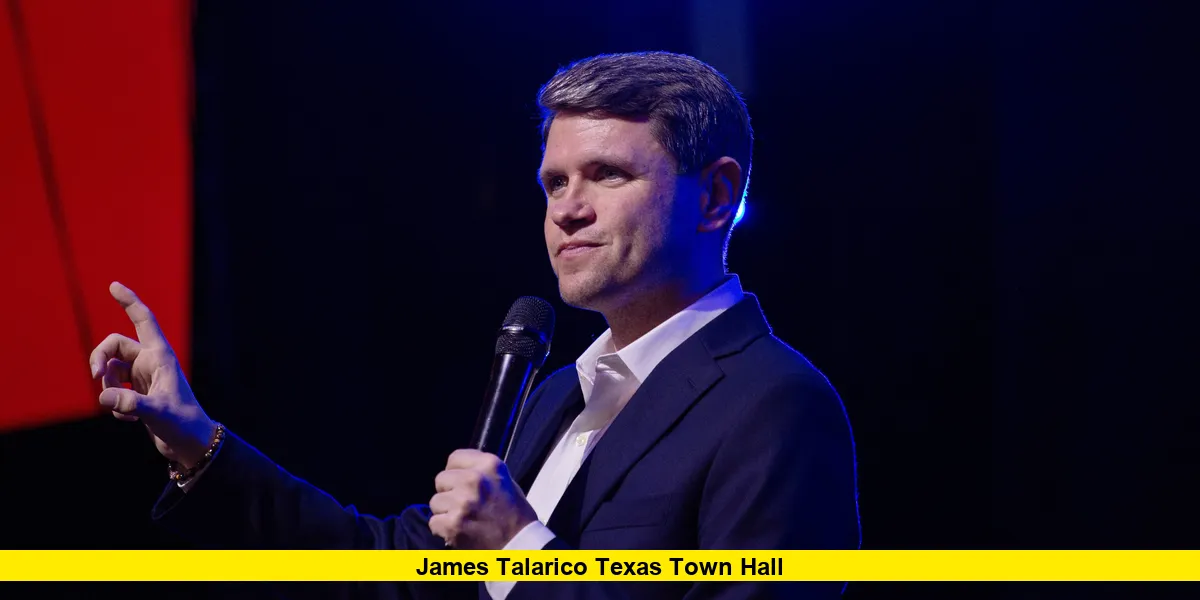
The James Talarico Texas town hall brought the Texas Democratic Senate candidate face-to-face with voters to discuss the economy, healthcare, immigration, energy policy, abortion, and political accountability. During a televised CNN and Jubilee Media town hall in Fort Worth on October 14, 2026, Talarico answered questions from Democrats, Republicans, and independent voters as the November midterm elections approached.
The 90-minute event gave Talarico an opportunity to explain his positions on issues affecting American families and address questions about his political record. He emphasized the rising cost of living, argued that political corruption contributes to economic problems, and outlined proposals intended to make government more accountable to ordinary Americans.
The town hall also addressed controversial subjects, including border security, religious beliefs, abortion policy, and the spread of misinformation online. Republican Senate nominee Ken Paxton was invited to participate but did not appear, leaving Talarico to answer the audience’s questions on his own.
Why the James Talarico Texas Town Hall Matters
The town hall took place during a closely watched Texas Senate contest between Democratic nominee James Talarico and Republican nominee Ken Paxton. The race has attracted national attention because Texas has traditionally favored Republican candidates in statewide elections, while the outcome of the Senate contest could influence control of the U.S. Senate.
Talarico used the event to reach voters who may not regularly follow campaign speeches or political advertisements. Instead of delivering a prepared address, he faced questions from people with different political affiliations and priorities.
The audience included approximately 20 Democrats, 20 Republicans, and 20 independent voters. Their questions covered subjects ranging from household expenses and government spending to energy production, immigration enforcement, and abortion.
This format created opportunities for voters to challenge Talarico directly. It also required him to explain his positions in language that could appeal to people who do not necessarily agree with his party.
Throughout the discussion, Talarico presented himself as a candidate willing to challenge both political parties when he believes their policies do not serve ordinary Americans. He criticized Republican policies while also acknowledging shortcomings within the Democratic Party.
His approach focused on a central campaign argument: economic problems cannot be addressed effectively without examining how political decisions are made and whose interests those decisions serve.
For voters, the town hall offered a closer look at Talarico’s priorities. However, his proposals remain campaign positions unless they are adopted through the appropriate legislative process.
Economy and the Rising Cost of Living
Economic affordability was one of the defining themes of the discussion. Many Americans face pressure from housing expenses, groceries, insurance premiums, transportation, utilities, and other recurring bills. These costs can make it difficult for households to save money, pay down debt, or prepare for unexpected expenses.
Talarico connected these financial pressures to what he described as a problem of political corruption. His argument was that powerful financial interests have too much influence over government decisions, allowing policies to benefit wealthy individuals and corporations rather than working families.
He presented economic affordability as an issue that extends beyond traditional disagreements between Democrats and Republicans. In his view, the question is whether government policies help ordinary people retain more of their earnings and improve their financial security.
Taxing Work and Wealth
Talarico described himself as a capitalist but criticized what he called crony capitalism. He argued that the existing economic system places too much emphasis on taxing income earned through work while allowing wealthy individuals to benefit from favorable tax provisions.
His position centers on the idea that people who earn wages should not face a disproportionately heavy burden compared with those whose resources come from accumulated wealth and investments.
Changing this balance would require detailed tax legislation. The effects would depend on the provisions lawmakers adopt, the people affected by those changes, and the amount of revenue the government collects.
Talarico’s comments established the direction of his economic argument, although they did not constitute a complete legislative blueprint with finalized tax rates or a comprehensive estimate of the financial impact.
For households, the practical questions include whether proposed changes would increase take-home pay, reduce costs, improve access to services, or create other economic consequences.
Government Spending and the Federal Deficit
Talarico also addressed the federal budget deficit, acknowledging that government spending should be examined for inefficiencies. He argued that lawmakers should look for ways to make government operations more effective rather than assuming that every existing program must remain unchanged.
He discussed closing tax loopholes benefiting billionaires, reducing government waste, and ending the war in Iran as parts of his approach to the deficit.
These proposals involve different policy questions. Closing tax loopholes could affect federal revenue, while reducing spending would require decisions about which programs or operations should change. Ending military involvement in a conflict would also involve diplomatic, national security, and budgetary considerations.
The overall effect on the deficit would depend on the details of the measures and how much money they raised or saved.
Talarico’s willingness to discuss government efficiency was also part of his effort to reach voters who may be skeptical of expanding federal spending. His argument was that accountability and responsible budgeting should apply regardless of which political party controls Washington.
Healthcare Costs and Access to Medical Care
Healthcare remains a significant concern for households across the United States. Insurance premiums, deductibles, prescription medications, and hospital bills can create financial pressure even for people who have health insurance.
The town hall provided an opportunity to discuss how federal policies could affect access to care and the amount families pay out of pocket.
Talarico has emphasized healthcare affordability as part of his broader policy agenda. His approach focuses on reducing medication costs, protecting access to health insurance, and increasing competition in the insurance market.
Prescription Drug Affordability
Prescription medication costs can be especially difficult for people who need treatment every month or depend on medication to manage chronic conditions.
Insulin affordability, in particular, has been a recurring national policy issue because people with diabetes may need the medication throughout their lives. Other essential drugs, including emergency allergy treatments and cancer medications, can also create substantial expenses.
Talarico has pointed to his legislative experience in Texas when discussing efforts to limit insulin copayments. He has also expressed support for broader measures intended to reduce prescription drug costs.
The impact of any drug-cost policy depends on its scope. A copayment limit may help eligible patients with certain insurance plans, but it does not necessarily eliminate every expense associated with obtaining medication.
Federal legislation could address additional aspects of drug pricing, although the outcome would depend on the specific provisions approved by Congress.
For consumers, the important considerations include eligibility, insurance coverage, pharmacy access, deductibles, and whether the policy applies to the medications they need.
Affordable Care Act Coverage
The Affordable Care Act, commonly called the ACA, provides a framework for health insurance marketplaces and financial assistance for eligible individuals and families.
Changes to marketplace subsidies or other insurance provisions can affect monthly premiums and the number of people who can afford coverage. The consequences vary according to household income, location, age, insurance options, and eligibility rules.
Talarico has opposed changes that he believes would make health insurance less affordable for Texans. His position reflects a wider debate over the federal government’s role in helping households purchase coverage.
The issue is especially important for people who do not receive health insurance through an employer. Self-employed workers, people working for small businesses, and families between jobs may rely on marketplace coverage.
However, the actual cost of a plan involves more than its monthly premium. Deductibles, copayments, prescription benefits, provider networks, and annual out-of-pocket limits also affect affordability.
Voters evaluating healthcare proposals should therefore consider whether a policy changes premiums, improves access to treatment, expands eligibility, or reduces other costs.
The Public Health Insurance Option
Talarico has supported the idea of a public option, which would provide a government-backed health insurance plan that could compete with private coverage.
Supporters of a public option argue that additional competition could give consumers more choices and potentially put downward pressure on insurance costs. They also argue that a public plan could offer an alternative for people who struggle to find affordable private coverage.
The details would be critical. Lawmakers would need to establish who could enroll, how the plan would be funded, what benefits it would provide, and how it would negotiate payments with healthcare providers.
The proposal would also need to address how a public plan would interact with employer-sponsored insurance, Medicare, Medicaid, and existing marketplace plans.
A public option is not the same as automatically replacing private insurance with a government-run system. Its practical design would determine how it operates and which Americans could benefit.
For Talarico, the proposal forms part of a broader argument that healthcare access and affordability should remain central public policy concerns.
Political Corruption and Government Accountability
Political accountability was closely connected to Talarico’s economic message. He argued that excessive influence from wealthy donors and powerful organizations can undermine public trust and make it harder for elected officials to prioritize ordinary voters.
He proposed reforms that would apply to both political parties rather than benefiting Democrats or Republicans alone.
Among the measures he discussed were congressional term limits, restrictions on super PACs, changes to gerrymandering, and limits on congressional stock trading.
Congressional term limits would restrict how long lawmakers could serve, depending on the structure of the proposal. Reforming gerrymandering would address concerns about how electoral district boundaries are drawn and whether those boundaries give one political party an unfair advantage.
Super PACs can raise and spend substantial amounts on political activity independently of candidates. Restrictions on their activities would have to account for existing campaign finance laws and constitutional protections involving political speech.
A ban or substantial restriction on congressional stock trading would seek to reduce concerns about conflicts of interest when lawmakers trade individual stocks while participating in decisions that could affect companies.
Each proposal would face different legislative and legal challenges. Some reforms could require federal legislation, while others might involve constitutional questions or changes to existing congressional rules.
Talarico argued that the objective should be to reduce the influence of money in politics and restore public confidence in government.
Immigration and Border Security
Immigration policy was another major topic during the town hall. Texas has a direct connection to the national immigration debate because of its border with Mexico, its workforce needs, and the economic importance of agriculture, energy, construction, and other industries.
Talarico acknowledged that border security was a legitimate concern. He said he believed the Biden administration had failed to secure the border adequately, while criticizing what he described as excessive enforcement practices under the current administration.
He said he did not support abolishing U.S. Immigration and Customs Enforcement, commonly known as ICE. Instead, he argued that the agency’s practices required scrutiny and reform.
His proposed approach included increasing the number of Border Patrol agents, improving surveillance technology, and expanding legal pathways for immigrants who want to work and contribute to the U.S. economy.
These proposals address separate elements of immigration policy. Border enforcement involves staffing, surveillance, inspections, and the prevention of unlawful crossings. Legal immigration pathways involve the rules governing employment, family reunification, asylum, and other categories of entry.
Congressional action would be required for many substantial changes to federal immigration law, while agency operations would also depend on existing legal authority and executive decisions.
The town hall showed how Talarico sought to combine border security with support for lawful immigration. Whether voters agree with that balance will depend on their views about enforcement, economic needs, humanitarian obligations, and the federal government’s responsibilities.
Energy Policy and the Texas Oil and Gas Industry
Energy policy is especially important in Texas, where oil and gas production supports jobs, investment, and local economies.
During the town hall, a voter raised concerns about the future of the state’s energy industry. Talarico responded by describing an all-of-the-above approach that would support renewable energy development while protecting oil and gas.
The position recognizes that Texas depends on a broad energy sector that includes traditional fossil fuels as well as expanding renewable resources.
Oil and gas remain important to employment, industrial activity, exports, and government revenue in many Texas communities. At the same time, renewable energy investments can influence electricity generation, infrastructure development, and the long-term composition of the state’s energy supply.
Talarico’s approach aims to avoid treating these energy sources as mutually exclusive.
However, questions remain about how policymakers should balance environmental objectives, production costs, electricity reliability, infrastructure investment, and the interests of workers in different parts of the energy sector.
Republicans have criticized Talarico’s previous legislative record on climate policy, including a bill he introduced that proposed substantial reductions in Texas carbon emissions over time. Talarico has maintained that his position on energy has been consistent.
The disagreement illustrates why voters may want to examine specific legislative proposals rather than relying only on broad campaign descriptions.
Abortion, Religion, and Personal Beliefs
The town hall also included challenging questions about abortion and religion. These subjects can be particularly sensitive in Texas, where abortion restrictions and religious beliefs play prominent roles in political debates.
A voter questioned Talarico about his support for abortion rights and asked how Catholic voters could trust his approach to protecting unborn life.
Talarico framed abortion as a public health issue and argued that reducing unplanned pregnancies could provide common ground for people who reach different moral conclusions about abortion.
The exchange demonstrated that candidates may face questions not only about their policy positions but also about the moral reasoning behind them.
Abortion policy involves several distinct considerations, including the circumstances under which abortion is legally permitted, the role of state governments, access to reproductive healthcare, and the potential scope of federal legislation.
Talarico’s comments reflected his position on the issue, but they did not settle the broader disagreement over abortion rights and restrictions.
Religion was another point of discussion. A small-business owner questioned Talarico about a previous statement describing God as nonbinary.
Talarico acknowledged that his earlier wording had been provocative and explained that he was discussing the difficulty of defining God through human categories. He also indicated that he was receptive to feedback from other Christians.
The exchange highlighted how his religious views intersect with his political identity. It also illustrated the challenges candidates face when explaining theological statements to audiences with different beliefs.
For voters, the relevant questions include what candidates actually believe, how they explain those beliefs, and whether their policy proposals align with the priorities of their constituents.
Misinformation and the Political Campaign
The town hall also addressed misinformation and the role of social media in political campaigns.
Before the event, Talarico had been the target of false online claims suggesting that he had received treatment at a mental health facility in Ohio. His campaign said he had been recovering from the flu.
The false allegations circulated while he was away from the campaign trail, creating a controversy that extended beyond his policy positions.
During the town hall, Talarico discussed what he described as a rage-driven online economy in which misleading claims can generate attention and engagement while increasing public anger.
The issue is relevant to voters because political misinformation can influence how candidates are perceived, particularly when allegations spread faster than verified information.
Claims about a candidate’s health, personal conduct, or background should be evaluated using reliable evidence rather than repetition on social media. A widely shared allegation is not necessarily a verified fact.
The episode also illustrated how political campaigns increasingly operate across television, digital platforms, online advertisements, and social media accounts.
For voters, the practical lesson is to distinguish between documented information, a candidate’s own statements, and allegations that have not been substantiated.
Ken Paxton’s Absence and the Texas Senate Contest
Republican nominee Ken Paxton did not participate in the town hall, despite being invited. His absence meant that Talarico answered questions without a direct exchange between the two candidates.
The event therefore offered viewers a detailed look at Talarico’s positions but did not provide a side-by-side comparison of the candidates’ answers to identical questions.
Paxton has promoted his record as Texas attorney general, including lawsuits involving local governments, pharmaceutical companies, and technology companies. His campaign has argued that his actions have helped protect Texans’ interests.
Talarico, by contrast, has emphasized affordability, political accountability, and concerns about Paxton’s financial and ethical controversies.
The candidates’ competing arguments reflect different approaches to the role of government and the responsibilities of elected officials.
Voters comparing the two campaigns can examine their policy proposals, legislative and executive records, public statements, and responses to questions about potential conflicts of interest.
The Senate race also has national implications because the result could affect the balance of power in Congress. However, the outcome will depend on the votes cast in the election rather than the performance of either candidate at a single town hall.
What the Town Hall Means for Texas Voters
The discussion offered several areas for voters to examine as the campaign continues.
First, healthcare affordability remains a practical issue for households managing insurance premiums, prescription expenses, and medical bills. Talarico’s proposals provide a basis for evaluating how he would approach these concerns in Washington.
Second, his economic message connects the cost of living to tax policy, government spending, and political influence. Voters can assess whether his proposed reforms offer sufficiently detailed explanations of how they would work.
Third, his positions on immigration and energy seek to address issues that have particular importance in Texas. His emphasis on border security alongside legal immigration pathways, and on renewable energy alongside oil and gas, presents a policy approach that voters can compare with those of his opponent.
Finally, the exchanges about abortion, religion, and misinformation demonstrate the importance of examining a candidate’s explanations rather than relying solely on campaign advertising or viral claims.
The next stage of the campaign will provide additional opportunities to assess the candidates’ proposals and how they respond to questions from Texas voters.
Final Thoughts on the James Talarico Texas Town Hall
The James Talarico Texas town hall placed economic affordability, healthcare, political accountability, immigration, and energy policy at the center of a wide-ranging discussion with Texas voters. Talarico used the forum to explain his priorities, address difficult questions, and present himself as a candidate willing to challenge political interests across party lines.
His proposals included measures aimed at lowering healthcare costs, changing federal tax policy, improving border security, protecting the Texas energy industry, and reforming political institutions. The event also highlighted disagreements about abortion, religion, and the influence of misinformation on public debate.
For voters, the key task is to distinguish campaign promises from policies that have actually been enacted. Examining the details of each proposal, comparing the candidates’ records, and seeking reliable information can help Texans make informed decisions as the midterm elections approach.
What did you think of James Talarico’s answers on the economy and healthcare? Share your views in the comments and follow the latest updates on the Texas Senate race.