May 2026 News
Virginia’s May 2026 redistricting rulings dealt Democrats a major setback by keeping the current 6-5 congressional map in place, weakening their broader national push to redraw House districts ahead of the midterms and intensifying the nationwide legal battle over partisan maps.
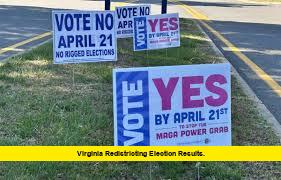
Virginia’s redistricting election results are in — and the ripple effects will be felt from Richmond to Capitol Hill. On April 21, 2026, voters in the Commonwealth approved a constitutional amendment that empowers the Democratic-controlled state legislature to bypass Virginia’s bipartisan redistricting commission and enact a dramatically redrawn congressional map. The decision reshapes the ongoing national redistricting war between Democrats and Republicans — one that will ultimately determine which party controls the U.S. House of Representatives after this fall’s midterm elections.
The stakes could hardly be higher. With a narrowly divided House currently under Republican control, every seat is precious territory. Virginia redistricting election results now open the door for Democrats to win as many as 10 of the state’s 11 congressional seats — up from the six they currently hold. That translates to a potential net gain of four seats, a number that, on its own, could tip the balance in November.
Follow the latest updates on the 2026 redistricting battle and House majority race — bookmark this page and subscribe to stay current as legal challenges and new maps unfold.
A Redistricting Arms Race That Started in Texas
To understand why Virginia matters so much, you have to go back to July 2025, when President Donald Trump urged Texas Republicans to redraw their state’s congressional districts in pursuit of additional GOP-friendly seats. According to NPR, that single move set off a nationwide redistricting chain reaction, drawing in California, Missouri, North Carolina, Ohio, Utah, and eventually Virginia.
As per the Associated Press, congressional redistricting is typically done once a decade following the U.S. census — but Trump pushed Texas Republicans to redistrict ahead of the November elections in hopes of winning several additional seats and maintaining the GOP’s narrow House majority. That gambit created a template and an arms race that neither party has been willing to step away from.
Per NBC News, six states — Texas, North Carolina, Missouri, Ohio, Utah, and California — enacted new maps in the last year, giving Republicans as many as nine new seats and Democrats up to six. Before Virginia’s vote, Republicans held a modest advantage in the redistricting exchange. Virginia’s “yes” result changes that math significantly.
How Virginia’s Vote Actually Works
The ballot measure was a proposed constitutional amendment — not a simple referendum. According to Ballotpedia, the amendment allows the Virginia General Assembly to conduct congressional redistricting between January 1, 2025, and October 31, 2030, provided another state first participated in congressional redistricting. Because Texas moved first, Virginia’s trigger condition was already met.
As per VPM News, after a landslide Democratic victory in Virginia’s 2025 state elections, the legislature passed the amendment again — a requirement under Virginia law — and sent it to voters along with a map designed to deliver 10 of Virginia’s 11 U.S. House seats to Democrats in the 2026 federal midterm elections.
According to VPM News, the new map goes into effect immediately following the vote — a sudden shift that places some residents in entirely different congressional districts. For example, some Rockingham County voters who were previously in the solidly red 6th Congressional District now find themselves in the new 11th District, sharing representation with voters from Fairfax County.
The Map Itself Is Extreme — Both Sides Agree on That
According to CNN, the map set to go into effect represents one of the most extreme political gerrymanders of the 2026 election cycle, giving Democrats an electoral advantage in 10 of the state’s 11 House districts.
As per VPM News, the new 7th District has been likened to a lobster — with a tail in deep-blue Northern Virginia and claws that stretch into the Shenandoah Valley and the western part of Greater Richmond. These are the kinds of contorted shapes that redistricting critics, regardless of party, have historically pointed to as evidence of partisan manipulation.
This is where the irony cuts deep. According to Ballotpedia, Governor Abigail Spanberger was among the two-thirds of Virginians who voted in 2020 to transfer redistricting from the legislature to a bipartisan commission, having previously stated that gerrymandering is detrimental to democracy. Now, as governor, she signed the bill scheduling the April 21 referendum that moved redistricting authority back to the legislature.
Spanberger and Democrats justify the reversal as a defensive necessity — not an ideological preference. The argument is essentially: we didn’t start this, but we refuse to lose it.
The National Scoreboard After Virginia
According to CNN, with Tuesday’s victory, Democrats have now redrawn 10 seats nationally to their advantage since Texas kicked off mid-decade redistricting, compared to Republicans’ nine. That is a meaningful shift from just weeks ago, when Republicans appeared to hold the upper hand.
As per NBC News, Republicans had hoped to insulate their three-seat House majority, but the result of the redistricting back-and-forth may end up being close to a wash. The numbers still leave Republicans with their majority intact on paper — but the cushion is gone, and the midterm environment already favors the party out of power.
Per NBC News, Republicans could still add to their total in Florida, where lawmakers have discussed drawing two to five new seats that would favor the party in a special legislative session. That fight is likely imminent, which means the national scoreboard could shift again in the weeks ahead.
A Spending War That Defined the Campaign
The Virginia referendum was not just a policy debate — it was a financial battle. According to CNN, supporters of the map spent more than $56.4 million on advertising through Tuesday morning, more than twice the $24.6 million invested by groups opposed to the map, per ad-tracking data from AdImpact.
National Democratic figures threw their weight behind the “yes” campaign. As per NBC News, supporters flooded the airwaves with early ads putting former President Barack Obama front and center. Governor Spanberger hit the campaign trail in support of the referendum, as did House Minority Leader Hakeem Jeffries of New York.
Republicans scrambled to close the gap late in the race. According to NBC News, when a public poll in early April gave Republicans some hope, they ramped up spending — narrowing a massive 17-to-1 spending disparity to a 3-to-1 Democratic advantage in the final stretch. Former Governor Glenn Youngkin, House Speaker Mike Johnson, and other Republican figures campaigned hard against the measure, focusing particularly on energizing voters in rural areas.
Trump entered the race at the very last minute. As per NBC News, he added a tele-rally to his schedule Monday night, called into a conservative radio show, and posted on his social media network urging Virginians to vote no. Virginia House Speaker Don Scott suggested the 11th-hour intervention backfired, telling reporters that Trump’s involvement only served to motivate Democrats further.
What Rural Virginia Had to Say
One of the most telling aspects of Tuesday’s vote was the tension it exposed between urban and rural Virginians — a divide that goes beyond partisan labels.
According to OPB, the concern was particularly acute among conservative voters in rural areas, many of which would be drawn into congressional districts dominated by Democratic-leaning cities and suburbs. One voter in South Hill, near the North Carolina border, said she cast her ballot against the amendment, explaining that rural areas simply need to be heard and that the population imbalance with Northern Virginia should not dictate their representation.
This is not simply a partisan complaint — it reflects a genuine structural tension in how representative democracy functions across a geographically and demographically diverse state. A rural voter in the Shenandoah Valley sharing a congressional representative with a suburban commuter in Fairfax County is not a comfortable arrangement for either constituency, and no redistricting outcome fully resolves that friction.
Turnout Told a Complicated Story
As per NBC News, voter turnout in the Virginia redistricting election tracked lower than during the 2025 gubernatorial election. In communities that have traditionally supported Democrats, total voter turnout came in around 87% of the 2025 general election figure, whereas turnout in Republican-supporting jurisdictions ran at approximately 96% of the gubernatorial vote.
According to NBC News, the largest shortfall was reported in Alexandria City, which came in about 21% lower than the same point during the gubernatorial election. Yet despite lower-than-expected Democratic enthusiasm in key urban and suburban strongholds, the “yes” side still prevailed — a result that speaks to how deeply the stakes registered even among reluctant or ambivalent voters.
As per NPR, the pro-redistricting side won narrowly, with the “yes” vote up by nearly 3 percentage points with an estimated 95% of results counted — far less than Democratic Governor Abigail Spanberger’s 15-point win last year or Kamala Harris’ nearly 6-point margin over Donald Trump in 2024.
That narrower-than-expected margin matters. It signals that even in a blue-leaning state, voters are not uniformly enthusiastic about partisan gerrymandering — even when it benefits their preferred party.
The Legal Battle Is Far From Over
A “yes” vote is not the final word. According to NPR, the Virginia Supreme Court has yet to rule on challenges to the redistricting effort, which could ultimately stop any new districts from being used in this year’s elections.
As per VPM News, multiple lawsuits have been filed by national and state Republicans — including GOP members of Congress whose seats are more vulnerable under the redrawn districts — in an effort to block the maps from taking effect.
According to VPM News, in the most high-profile legal challenge, a Tazewell County judge ruled that Democrats’ redistricting push was improperly conducted and temporarily blocked it. The Virginia Supreme Court ordered the referendum to proceed to voters regardless, with justices indicating they would rule on the merits after the election if needed.
The legal landscape ahead is murky and likely to produce more disruption before November. If Virginia’s Supreme Court ultimately nullifies the referendum, Democrats would lose their hard-won gains overnight — a scenario that makes the coming months as consequential in the courtroom as at the ballot box.
A Comparison Worth Making: California vs. Virginia
The Virginia result did not occur in isolation. According to NPR, shortly after Texas Republicans drew their new maps, California voters backed a plan to create seats favorable to Democrats — an action that essentially offset Republican gains out of Texas. Because Missouri and North Carolina Republicans subsequently created additional GOP-leaning seats, Republicans held a slight national edge heading into the midterms. Virginia’s result erases that edge.
The California-Virginia pairing is instructive. Both were Democratic-controlled states that used voter referendums to enact partisan maps in direct response to Republican actions elsewhere. The difference is that California is the largest state in the union, while Virginia — with only 11 congressional seats — required a much more surgical, maximum-efficiency gerrymander to deliver comparable national impact. The proposed 10-1 split is, seat-for-seat, one of the most aggressive partisan maps drawn in this redistricting cycle by either party.
What This Means for House Control in November
To win the House majority, Democrats need to flip only a handful of seats from the current Republican configuration. As per PBS NewsHour, Virginia currently has six Democrats and five Republicans in its congressional delegation — but if the new plan is enacted, the party could gain the upper hand in 10 districts, representing a net pickup of four seats.
Four seats. In a chamber where the majority has fluctuated within a margin of three to ten seats for years, four seats from a single state could be decisive. Add in the well-established historical pattern that the president’s party loses ground in midterm elections, and the Republican majority faces genuine structural pressure heading into November — pressure that Virginia’s redistricting result just intensified.
According to NBC News, Democrats have already outperformed past results in special elections throughout 2025 and 2026. If that trend extends into the general midterm elections, it could erode some of the districts drawn to be more Republican-friendly in states like Texas. In other words, the redistricting math assumes competitive races that Republicans win narrowly — and if the political environment continues shifting against the party in power, those assumptions unravel quickly.
Virginia redistricting election results are now a central variable in the national equation. The maps are drawn. The legal battles are underway. And November is coming fast.
What’s your take on mid-decade redistricting — a necessary democratic countermeasure, or a threat to fair representation? Drop your thoughts in the comments below and stay current on every legal ruling and election development as the 2026 midterms take shape.
The fight over who controls the U.S. House may ultimately be decided not on Election Day — but in a Virginia courtroom, over maps that voters approved by just three points.