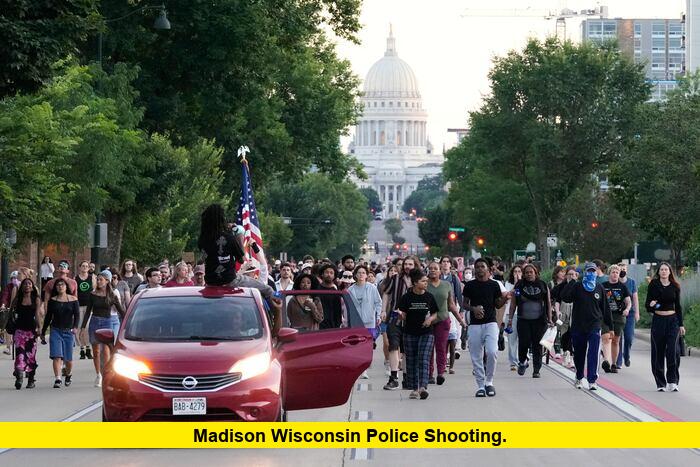
A Madison, Wisconsin police shooting on July 22, 2026, has left one man dead and prompted an outpouring of public anger, protests, and renewed scrutiny of law enforcement practices in the state capital. The fatal encounter unfolded on the city’s Near East Side, just blocks from the Wisconsin State Capitol, in a neighborhood already familiar with the pain of a similar tragedy from a decade earlier. As bystander video of the shooting spread rapidly across social media, residents gathered at the scene and later marched toward the Capitol demanding transparency and accountability.
What Happened on Williamson Street
According to Madison Police Chief John Patterson, officers were dispatched to the Marquette neighborhood just after 1 p.m. on Wednesday, July 22, 2026, after receiving a report of a man attempting to enter parked vehicles. When officers located the man and tried to make contact, he fled the area on a bicycle. Police caught up with him again at the intersection of Williamson Street and South Baldwin Street, roughly two miles from the State Capitol building.
Bystander footage from the scene shows several officers attempting to restrain the man on the ground, with a bicycle visible lying nearby in the street. Chief Patterson said the man produced a knife and injured an officer during the struggle. Moments later, one officer opened fire. Cellphone video circulating online captured three gunshots during the altercation. The man, described by police as being in his 30s, was pronounced dead at the scene. As of this writing, police have not publicly released his name, and there is no official confirmation of his identity beyond his approximate age.
Four officers were reportedly involved in the encounter, though Chief Patterson confirmed that only one officer discharged a firearm. All four officers involved have been placed on administrative leave, which is standard procedure following an officer-involved shooting in Wisconsin.
Public Interest and Community Reaction
The Madison Wisconsin police shooting has drawn intense public interest, in part because of its unsettling echo of history. The shooting occurred less than two blocks from the site where Madison police officer Matt Kenny fatally shot 19-year-old Tony Robinson in 2015, a case that ignited widespread protests across the city and drew national attention to policing practices in Madison. Robinson, who was biracial and unarmed at the time, died after the Dane County District Attorney determined the officer had acted in justified self-defense, and no charges were filed.
That history was not lost on residents who gathered at the scene of Wednesday’s shooting. While police have not released the race of either the officer or the man who died, community advocates said the man killed appeared to be Black. Brandi Grayson, head of the Madison-based advocacy group Urban Triage, said the community watched the man die before even learning his identity, calling the incident an example of state violence. Chief Patterson acknowledged the weight of the moment, referencing the Robinson case directly during his press conference and describing Wednesday’s incident as a deeply traumatic event for the city.
Protesters gathered at the intersection of Williamson and South Baldwin streets throughout Wednesday evening, with crowds chanting for officers to be held accountable and demanding the responding officer’s name be released. Some demonstrators later marched toward the Wisconsin State Capitol, continuing calls for transparency into the late evening hours. Multiple streets in the surrounding area were blocked off as officers worked to secure the scene.
A recurring point of criticism among advocates and City Council members has been the fact that Madison Police Department officers typically do not wear body cameras, meaning key portions of Wednesday’s shooting may not have been captured on official footage. This detail has fueled additional calls for expanded police oversight and equipment reform in the city.
Investigation and Next Steps
As required under Wisconsin law, any officer-involved shooting must be investigated by an outside agency rather than the department involved. The Wisconsin Department of Justice’s Division of Criminal Investigation has taken over the inquiry into Wednesday’s shooting. Chief Patterson said he expects a full, comprehensive, and transparent independent investigation and pledged to work closely with the city’s Office of the Independent Monitor throughout the process.
Once the Division of Criminal Investigation completes its review, the findings will be forwarded to Dane County District Attorney Ismael Ozanne, who may then decide whether criminal charges are warranted against any of the officers involved. There is no official timeline yet for when that investigation will conclude, and no charges have been filed as of this writing. Given the complexity of past officer-involved shooting investigations in Dane County, this process may take weeks or months before conclusions are announced publicly.
Broader Context: Officer-Involved Shootings in Madison
Wednesday’s incident is not the first time Madison has experienced a fatal police shooting, and the city’s history with these events has shaped much of the public reaction. Beyond the 2015 death of Tony Robinson, Madison has recorded other officer-involved shootings in past years, including a 2019 incident in which police shot and killed a 63-year-old man on the city’s west side after he reportedly fired at responding officers. Each of these cases has, to varying degrees, renewed conversations in Madison about use-of-force policies, body camera adoption, and the relationship between police and the communities they serve.
For a city that has positioned itself as progressive and reform-minded on many social issues, repeated fatal encounters between police and community members — particularly Black residents — have kept pressure on city leadership to implement lasting changes. Advocacy organizations like Urban Triage have used moments like this one to renew demands for structural reforms, including greater civilian oversight of police conduct and mandatory body-worn cameras for all patrol officers.
Final Thoughts
The Madison Wisconsin police shooting on July 22, 2026, has reopened difficult conversations in a city still marked by the legacy of the 2015 Tony Robinson case. While Chief John Patterson has emphasized that the widely circulated bystander video represents only one perspective of a fast-moving and dangerous encounter, community members and advocacy groups are pressing for full transparency, including the release of the involved officer’s identity and a thorough independent investigation.
At this stage, many details remain unconfirmed, including the identity of the man who was killed, the race of the officer involved, and whether any additional information from body-worn or dashboard cameras exists. The Wisconsin Department of Justice’s investigation is expected to shape much of what the public eventually learns about the exact sequence of events on Williamson Street. Until that investigation concludes, official statements from the Madison Police Department and the Division of Criminal Investigation remain the most reliable source of confirmed facts, while much of the broader public discussion continues to be shaped by bystander video and community testimony rather than verified findings.
Stay tuned for updates on this developing story, and share your thoughts in the comments below.