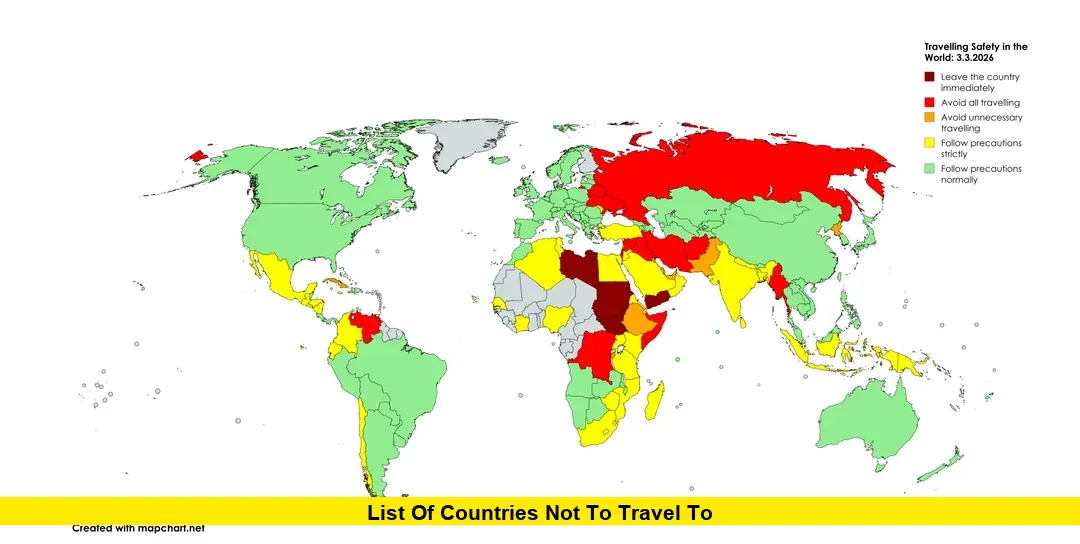
If you are planning international travel this year, there has never been a more important moment to stop, take a breath, and consult the full list of countries not to travel to before you do anything else. The global safety landscape in 2026 looks dramatically different from what it did just twelve months ago. The United States Department of State has not only updated its country-specific travel advisories — it has issued a sweeping worldwide alert that affects every American currently abroad or planning to leave the country. From active war zones to cartel-controlled regions, from rogue state detention risks to new geopolitical flashpoints, the current travel environment demands your attention.
This article breaks down everything you need to know: which countries carry the highest danger designations, what the warning levels actually mean, what is happening on the ground in places like Mexico, and how Americans can protect themselves when they travel — or make the informed decision not to travel at all.
🔴 Don’t book a single international flight until you’ve read this. What you don’t know could put your life at risk.
How the U.S. Travel Advisory System Works
Before diving into the specific destinations you should avoid, it helps to understand the framework the U.S. government uses to categorize travel risk. The State Department divides the world into four advisory levels, each carrying a specific recommendation for American citizens.
Level 1 is the lowest tier, labeled “Exercise Normal Precautions.” Countries in this category are generally stable and safe for American visitors. Think Canada, Australia, Ireland, Japan, Portugal, and a handful of Caribbean island nations. Even at Level 1, travelers are reminded that some risk always exists when traveling internationally, but nothing unusually elevated.
Level 2 carries the label “Exercise Increased Caution.” This designation covers a broad range of conditions — elevated crime rates, terrorism threats, kidnapping risks, or health and infrastructure concerns that do not rise to the level of discouraging travel outright. France, Germany, the United Kingdom, and Mexico overall fall into this category. Millions of Americans visit Level 2 countries every year without incident, but these advisories are reminders to stay aware and not be complacent.
Level 3 is where the calculus shifts significantly. Designated “Reconsider Travel,” Level 3 advisories communicate that serious safety risks exist and that non-essential trips should be reconsidered. This is the tier for destinations experiencing significant instability, terrorist activity, or government-level hostility toward American citizens. If you receive a Level 3 advisory for a destination you planned to visit, you should have a very compelling reason to continue with your plans — and you should be consulting with your employer, insurance company, and travel professionals before doing so.
Level 4 is the maximum warning: “Do Not Travel.” This is not a suggestion. When the State Department issues a Level 4 advisory, it is communicating that conditions in that country present life-threatening risks — armed conflict, terrorism, extreme crime, kidnapping, wrongful government detention — and that the U.S. government’s ability to help you in an emergency is severely limited or completely nonexistent. Airports may be closed. Embassies may be operating at minimal capacity or evacuated. Your insurance almost certainly will not cover you. You are, in the most literal sense, on your own.
There is also a fifth mechanism that goes beyond country-specific advisories: the Worldwide Caution. This is the State Department’s broadest possible alert, issued when conditions globally — not in one or two countries — present elevated risk for American citizens. In March 2026, the State Department issued exactly this kind of alert, and the context behind it is something every traveler must understand.
The Worldwide Caution of March 2026: Why the Entire Map Changed
On March 22, 2026, the U.S. Department of State issued an updated Worldwide Caution, urging all Americans — whether at home planning trips or currently overseas — to exercise heightened vigilance. The trigger was an escalation in the ongoing conflict involving Iran and the United States, a situation that had been building through early 2026 and reached a new threshold in late March.
Iranian military officials publicly stated that tourist destinations, parks, hotels, and recreational areas anywhere in the world would no longer be safe for people associated with the United States or its allies. That kind of open threat from a foreign government — broadcast on state-controlled television — is not something the State Department takes lightly, and American travelers should not either.
The practical consequence of this alert is that the risk of being targeted as an American is no longer limited to active conflict zones. U.S. diplomatic facilities outside the Middle East have already been targeted. Groups affiliated with or sympathetic to Iran operate in multiple regions across Asia, Europe, and Latin America. The threat is asymmetric, unpredictable, and global in scope.
Periodic airspace closures have disrupted flight routes, particularly in the Gulf region and Eastern Mediterranean. More than 46,000 commercial flights were canceled or rerouted in the weeks following the escalation, affecting travelers across dozens of countries. For anyone with Middle East travel plans — or layovers through that corridor — the disruptions alone have created logistical nightmares, regardless of safety concerns.
This Worldwide Caution sits on top of all the country-specific advisories. It does not replace them. It amplifies them.
The Full List of Countries Not to Travel to in 2026
As of April 2026, 22 countries and territories carry the State Department’s highest Level 4 “Do Not Travel” designation. Each has its own particular combination of threats, but all share one thing in common: the U.S. government has determined that the risks to American citizens are too severe to recommend travel under any normal circumstances.
Here is the current complete list, along with the primary reasons for the designation:
Afghanistan — The Taliban-controlled government has imposed extreme restrictions on civil life, particularly for women. Terrorist groups including ISIS-Khorasan continue to conduct attacks inside the country. U.S. consular services are entirely absent, as the embassy was evacuated following the Taliban takeover. Any American who finds themselves in Afghanistan in a crisis situation has essentially no government support to fall back on. The advisory was updated in February 2026.
Belarus — The government of Alexander Lukashenko has demonstrated willingness to detain foreign nationals, including Americans, on politically motivated charges. The country’s continued alignment with Russia following the invasion of Ukraine has introduced additional layers of risk. U.S.-Belarusian relations remain at a low point, and consular access is heavily restricted. The advisory update came in late December 2025.
Burkina Faso — Jihadist insurgencies linked to both al-Qaeda and ISIS affiliates have expanded dramatically across this West African nation. Kidnappings of foreigners occur regularly, and the military junta government has expelled foreign military partners while curtailing press freedom. Large portions of the country are effectively outside government control. The updated advisory was issued in April 2025.
Burma (Myanmar) — A military coup in February 2021 plunged the country into a state of armed conflict that has only deepened in the years since. Fighting between the military junta and various resistance forces affects wide swaths of the country. Arbitrary detention of foreigners has been documented, and the U.S. government has very limited ability to assist citizens inside the country. The advisory was updated in May 2025.
Central African Republic — Armed militias control significant portions of territory outside the capital. Killings, kidnappings, and attacks on aid workers and civilians are common. The government lacks the capacity to protect foreign nationals, and UN peacekeepers themselves face regular attack. Infrastructure is minimal and emergency evacuation options are extremely limited.
Gaza — The ongoing military conflict has devastated infrastructure throughout the territory. Civilian casualties are severe, and the ability of any government — including the United States — to provide assistance to people inside Gaza is essentially nonexistent under current conditions. The advisory status reflects the reality that no American should be attempting to enter this territory.
Haiti — Gang control over large portions of Port-au-Prince and surrounding areas has reached a point where the elected government exercises minimal authority over day-to-day life. Kidnapping for ransom is rampant, targeting both locals and foreigners. Airport operations have been intermittently disrupted. The State Department has gone so far as to advise Americans already in Haiti to shelter in place during periods of heightened violence, and has strongly urged all others to depart.
Iran — Iran sits at the epicenter of the current global security alert. The risk of wrongful detention for American citizens in Iran is severe and well-documented — Iran has a history of arresting U.S. passport holders on fabricated charges and using them as bargaining chips in diplomatic negotiations. The State Department has explicitly warned that simply carrying a U.S. passport in Iran puts you at elevated risk of arrest. There are no U.S. diplomatic or consular services in Iran, meaning an American detained there has no direct government channel to turn to.
Iraq — The advisory for Iraq was updated in March 2026, elevated in part due to the broader Iran-related escalation. Militia groups aligned with Iran operate with significant freedom across parts of the country, and U.S. military interests are regularly targeted. The security environment can deteriorate rapidly and with little warning, and civilian areas have been caught in the crossfire.
Lebanon — Lebanon received a fresh Level 4 advisory in February 2026, reflecting instability along the southern border and the ongoing risk of rapid escalation involving Hezbollah. The country’s economy has been in severe crisis for years, and the infrastructure for supporting foreign nationals in an emergency is extremely weak. The advisory update directly preceded a period of renewed cross-border hostilities.
Libya — Libya has effectively functioned as a divided state since the 2011 revolution, with competing governments and armed factions controlling different regions. Kidnapping, murder, and arbitrary detention by armed groups are persistent risks. There is no unified national security force capable of protecting foreign nationals. U.S. consular operations inside the country are suspended.
Mali — Like Burkina Faso, Mali has seen an explosion in jihadist activity, particularly in the central and northern regions of the country. The expulsion of international peacekeeping forces and foreign military advisers has left a security vacuum that extremist groups have rapidly filled. Kidnappings of Western nationals remain a significant threat. The advisory was updated in January 2026.
Niger — Following a military coup, Niger expelled French and U.S. military personnel and has increasingly aligned with Russia. Jihadist groups operate across the Sahel region that includes Niger, and the risk of violence against foreigners — including kidnapping — is high. Government capacity to assist or protect foreign nationals is minimal.
North Korea — North Korea is unique on this list because travel there is not just dangerous — it is effectively prohibited under U.S. law. Since the death of American student Otto Warmbier in 2017, the U.S. government has invalidated American passports for travel to North Korea, meaning you would need a special validation just to attempt entry legally. There are no U.S. consular services inside the country. North Korea lacks reliable infrastructure, and the risk of wrongful detention is extreme. The government has not shown meaningful flexibility in cases involving detained Americans.
Russia — Russia’s ongoing war against Ukraine, now in its fourth year, has produced a security environment deeply hostile to Americans. The Russian government has detained American citizens on what the U.S. characterizes as politically motivated charges, and several Americans remain in Russian detention as of this writing. The State Department explicitly warns of the risk of wrongful detention, and bilateral relations between the U.S. and Russia are at historic lows. Commercial flight options to and from Russia are severely curtailed following Western sanctions.
Somalia — Al-Shabaab, the al-Qaeda-linked terrorist organization, continues to carry out attacks across Somalia, including in the capital Mogadishu. Piracy remains a risk in offshore waters. The government has limited control outside urban centers, and U.S. consular services are non-operational inside the country. Kidnappings of foreigners occur.
South Sudan — Armed conflict between government and opposition forces continues to displace millions of civilians. Intercommunal violence is widespread. The humanitarian situation is severe, with food insecurity, disease outbreaks, and the near-total collapse of civilian infrastructure in many areas. Evacuation options are extremely limited.
Sudan — Sudan has been engulfed in catastrophic civil war since April 2023, when fighting broke out between the Sudanese Armed Forces and the Rapid Support Forces paramilitary group. Entire cities have been devastated. Millions of people have been displaced. Atrocities against civilians have been documented. The U.S. Embassy in Khartoum was evacuated. Americans who choose to go to Sudan do so with essentially no safety net.
Syria — Syria remains a deeply dangerous country despite some changes in governmental control following the fall of the Assad regime in late 2024. Multiple armed factions continue to contest territory, and the country’s infrastructure — physical, economic, and governmental — is in an extremely fragile state. Jihadist organizations retain presence in parts of the country. The advisory was updated in December 2025.
Ukraine — Russia’s full-scale invasion of Ukraine continues, with regular missile and drone strikes affecting cities across the country, including areas far from the front lines. The State Department maintains its Level 4 advisory for Ukraine, though acknowledging the complex situation of Americans who may have business or family ties there. The risk of being caught in an aerial bombardment is real for anyone traveling to Ukraine.
Venezuela — Venezuela’s advisory was elevated to Level 4 in December 2025. A dramatic U.S. military operation in January 2026, which resulted in the detention of President Nicolas Maduro on narco-terrorism and drug trafficking charges, has dramatically destabilized what was already a fragile situation. Crime rates are extreme, kidnapping is common, and the political situation remains highly volatile.
Yemen — Yemen has been in a state of devastating civil war for years, with a humanitarian catastrophe unfolding across the country. Multiple armed factions including Houthi rebels control different parts of the country. The Houthis have specifically targeted commercial shipping and have demonstrated the capability and willingness to launch missile and drone strikes at international targets. The advisory was updated in December 2025.
Countries to Avoid Visiting: The Level 3 Expansion in 2026
While Level 4 countries get the most attention, the rapid expansion of Level 3 advisories in 2026 is equally significant for everyday American travelers. Several destinations that millions of Americans would consider visiting under normal circumstances have been reclassified this year.
In the Middle East, Saudi Arabia, Oman, Kuwait, Bahrain, Qatar, and the United Arab Emirates have all been elevated to Level 3. For travelers who had planned business trips to Dubai or Abu Dhabi, family visits to Riyadh, or vacations in the region, this represents a meaningful shift. The reason is the Iran conflict and its ripple effects: the threat of missile or drone attacks, regional spillover from the broader conflict, and disruptions to civilian infrastructure are all documented concerns. Airspace closures in the Gulf have already affected thousands of flights.
In the Americas, Colombia, Honduras, and Nicaragua carry Level 3 designations. Colombia has made enormous progress over the past two decades in reducing violence, and major cities like Medellín and Bogotá attract millions of tourists each year. But the State Department still asks Americans to reconsider travel to Colombia overall due to ongoing risks from criminal organizations, kidnapping, and regions where government authority remains contested. Honduras and Nicaragua present their own complex security and political challenges.
Pakistan, with a Level 3 advisory, remains a destination that requires serious consideration before any American plans a visit. The security environment in border regions — particularly near Afghanistan — is extremely dangerous, with active militant groups. Even in urban areas, the risk of targeted attacks on Western nationals exists.
Ethiopia and parts of East Africa have seen escalating instability in recent years, and the advisory landscape for the region reflects genuine concern about conflict zones and kidnapping risks that have expanded beyond historically dangerous corridors.
Is It Safe to Travel to Mexico Now?
Mexico deserves a detailed discussion because it sits in a genuinely complicated space — it is one of the most visited countries in the world for Americans, it is geographically right next door, and yet different parts of it carry vastly different risk profiles, including some areas at the most severe Level 4 designation.
The overall country advisory for Mexico is Level 2 — “Exercise Increased Caution.” That places it in the same general tier as France, Italy, and Germany. But the nuance is critical: Mexico is not assessed as a single uniform destination. The State Department evaluates it state by state, and the variation is dramatic.
In February 2026, Mexico experienced a period of severe violence following the killing of Nemesio Oseguera Cervantes, the leader of the Jalisco New Generation Cartel, known as “El Mencho,” in a military operation on February 22. His death triggered a wave of retaliatory violence across multiple states. Burning vehicles, road blockades, and armed confrontations spread through Jalisco, Tamaulipas, parts of Michoacan, and elsewhere. Airlines canceled hundreds of flights to Puerto Vallarta and Guadalajara. The State Department issued shelter-in-place advisories for Americans in affected areas.
The immediate crisis stabilized relatively quickly. By February 25, shelter-in-place orders were lifted in most areas, and by early March, flight schedules had returned to normal. The U.S. Embassy issued a formal spring break safety alert on March 2, acknowledging the return to stability while reminding travelers that baseline safety risks remain.
The broader reality of Mexico travel safety comes down to geography and behavior.
States including Cancun’s home state of Quintana Roo, Mexico City’s Federal District, Oaxaca, Merida, and Baja California Sur have historically been among the safer destinations for American tourists, and they continued operating normally even during the February violence. Cancun remains at Level 2, which is the same designation it has held for years. The tourist infrastructure in Cancun, Los Cabos, Puerto Vallarta outside of crisis periods, and the Riviera Maya is designed with a significant security presence, including National Guard patrols and tourism police.
On the other end of the spectrum, states including Sinaloa, Colima, Tamaulipas, and specific areas of Michoacan, Guerrero, and Zacatecas remain at Level 4 within the state-by-state advisory framework. These are not destinations for American tourists. They are active operating zones for major cartel organizations, where gun battles, kidnappings, and assassinations are regular occurrences. U.S. government employees are prohibited from traveling to many of these areas, which serves as a meaningful signal about their safety.
The fundamental rule of travel to Mexico in 2026 is this: know where you are going before you go. Cancun and Colima are both in Mexico. The experiences and risk profiles are not comparable. Travelers who do their homework, stay within known tourist zones, use vetted transportation, avoid traveling at night on highways, and register with the Smart Traveler Enrollment Program will likely have a safe and enjoyable trip to appropriate Mexican destinations. Those who wander into high-risk states without understanding the dynamics of organized crime in those regions take on real and serious danger.
Regarding the FIFA World Cup, which Mexico is co-hosting with the United States and Canada in summer 2026, security analysts have expressed cautious optimism that major events in Guadalajara, Mexico City, and Monterrey will proceed safely. Cartels historically do not target high-profile international events, as the resulting crackdown harms their operations. Travelers attending World Cup matches should nonetheless monitor state-specific advisories and follow event-specific security guidance as it develops.
Travel Warnings for U.S. Citizens: The Practical Checklist
Understanding which countries carry warnings is the first step. Taking action before, during, and after your trip is what actually keeps you safe. Here is what every American traveler needs to do before any international departure in 2026.
Enroll in STEP. The Smart Traveler Enrollment Program is free, takes about five minutes to complete online at travel.state.gov, and could be the most valuable five minutes you spend before any international trip. By registering your trip, the nearest U.S. embassy or consulate can reach you directly in an emergency — whether that is a natural disaster, civil unrest, or a personal crisis. It also helps the State Department account for American citizens during evacuations. This is not optional; it is the baseline.
Check the advisory level for your specific destination. Do not simply look at the country-level advisory and move on. Mexico is a perfect example of why this matters. Check the regional and state-level breakdowns for any country with complex security conditions. A Level 2 overall designation can mask Level 4 conditions in specific areas.
Review your travel insurance carefully. Standard travel insurance policies almost universally exclude coverage for incidents in Level 4 designated countries. They may also exclude coverage for incidents in Level 3 countries if the advisory was in place before you purchased the policy. Read the fine print. If you are traveling to a destination with elevated risk, consider purchasing specialized travel security insurance that explicitly covers medical evacuation, security evacuation, and kidnapping-related incidents. Medical evacuations alone can exceed $100,000 without coverage.
Register your passport and keep copies. Keep digital and physical copies of your passport in multiple locations — email, secure cloud storage, a trusted contact at home. If your passport is lost or stolen in a Level 3 or Level 4 country where consular services are limited, having a copy of the document dramatically simplifies the process of getting emergency travel documents.
Have an exit plan before you arrive. Know where the nearest U.S. embassy or consulate is. Know multiple routes out of the city you are staying in. Understand which airports are operational and which ground routes are viable. In a fast-moving crisis, the people who survive are the ones who made their exit plan before something happened, not during.
Maintain a low digital profile in high-risk areas. The advice about not sharing your real-time location on social media is not paranoia — it is practical security hygiene. In countries where armed groups target Americans or where kidnapping is a risk, broadcasting your location at a hotel, restaurant, or tourist site creates unnecessary vulnerability. Turn off location services on social media posts. Avoid checking in at locations in real time.
Know the emergency number for your destination. 911 works in some countries (including Mexico, Canada, and parts of Europe), but many countries have different emergency numbers. Know who to call before you need to call someone.
Brief your family and leave a detailed itinerary. Someone at home should know exactly where you are going, where you are staying, and how to reach you. In the event of a crisis in which communications are disrupted, having a trusted person at home who knows your last known location and itinerary makes it significantly easier for authorities to locate you.
What to Do If You Are Already in a High-Risk Destination
For Americans who are currently abroad in or near a high-risk region, the guidance is more immediate.
If you are in a country under a Level 4 advisory, the State Department’s advice is to depart if you can do so safely. This is the most important action you can take. Do not wait for a crisis to escalate before making your exit. If conditions are stable enough to leave, leave.
If you are in a Level 3 country and conditions deteriorate, monitor official U.S. Embassy alerts closely. The Embassy will issue Security Alerts through the STEP program and its official website when conditions change. Do not rely on social media, which during the February 2026 Mexico crisis was flooded with outdated videos and false information about conditions in areas that were actually stable.
Shelter in place if instructed to do so. The natural impulse during a security crisis is to get moving — to try to get to the airport or out of the country immediately. But in situations involving road blockades, civil unrest, or military operations, moving through the streets can put you in greater danger than staying in a secure location. Listen to the official guidance from the U.S. Embassy and local authorities before making any movement.
Keep emergency contacts saved in your phone and backed up elsewhere. Have cash on hand — in local currency and in U.S. dollars — because ATMs and electronic payment systems frequently fail during civil disturbances.
The Bigger Picture: Global Travel in 2026
It would be easy to read this article and conclude that the world is simply too dangerous for Americans to travel internationally. That is not the right takeaway.
The vast majority of the world’s countries — well over 150 of them — are accessible to American travelers with standard precautions. Western Europe, most of Asia, much of Latin America, Canada, Australia, New Zealand, Japan, South Korea, and dozens of other destinations are welcoming millions of tourists this year. There is tremendous beauty, culture, history, and human connection available to travelers willing to approach the world with intelligence and preparation.
What 2026 requires is a different relationship with pre-trip research. The era of booking a flight based on a good deal and figuring out the details later is over for destinations near the current global flashpoints. The era of traveling to conflict-adjacent regions without specialized insurance, exit plans, and real-time monitoring tools is over.
The State Department’s advisory system exists precisely to make this kind of informed decision-making possible. It is not designed to frighten travelers away from the world. It is designed to give you the information you need to travel safely — and to clearly identify the places where, right now, no amount of preparation can adequately mitigate the risks.
Know the list. Understand the warnings. Take the precautions. And when the State Department says do not travel, take that advice seriously.
If you’re planning international travel in 2026 or you’ve recently returned from a destination on the advisory list, share your experience in the comments — your firsthand perspective could help fellow travelers make smarter, safer decisions.