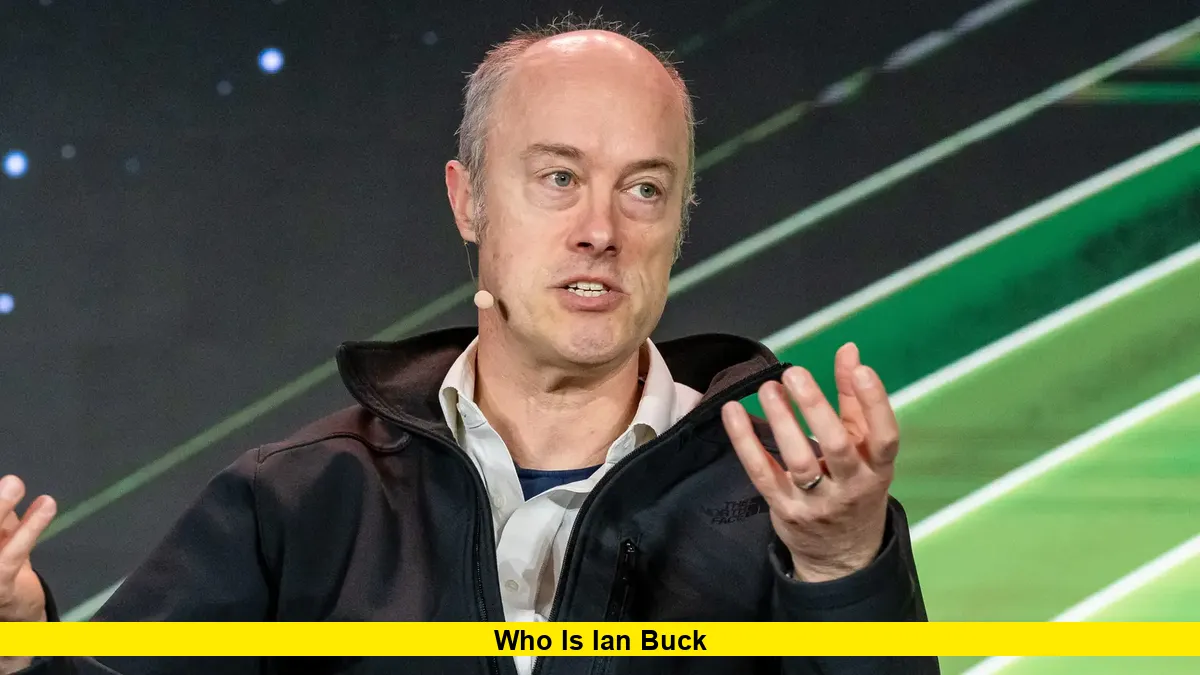
Who is Ian Buck? He is the Nvidia vice president who created CUDA, the software platform that turned graphics chips into the engines of modern artificial intelligence. He now runs the company’s hyperscale and high-performance computing business, which sells AI hardware and software to Microsoft, Google, Amazon, Meta and OpenAI.
His name surged in search on Nov. 12, 2026. Prediction-market traders and business outlets began naming him as a possible future Nvidia CEO. Here is what is confirmed about Buck, his role, his reported wealth and the speculation around him.
Ian Buck at Nvidia: Role and Responsibilities
Buck holds the title of vice president and general manager of hyperscale and high-performance computing at Nvidia. As head of product for hyperscale AI, he manages the hardware and software that big cloud companies use to build and deploy generative AI. Nvidia’s own author page for Buck describes that remit and his role in launching general-purpose GPU computing.
Fortune put him on its 2025 list of the most powerful rising executives. AIwire named him a 2025 Person to Watch. He has spent roughly two decades at the company, joining in 2004.
His business unit is the part of Nvidia closest to its biggest customers. That makes the Ian Buck Nvidia connection central to how the company sells its most expensive chips.
How Ian Buck Created CUDA
Buck’s path began in academia. He studied at Princeton, then earned his computer science PhD at Stanford. There he led development of Brook, an early programming language that let researchers run general computing tasks on graphics processors.
Reports describe an early Stanford experiment from 2000 in which he linked 32 GeForce cards to run Quake III at extreme resolution. That project pushed him toward the idea that GPUs could do far more than draw game graphics.
His 2004 dissertation, Stream Computing on Graphics Hardware, caught Nvidia’s attention. The company hired him that year. He later worked alongside Nvidia architect John Nickolls, and CUDA reached its first public release on Feb. 16, 2007.
CUDA was a team effort, and Nvidia credits Buck as its creator and a lead architect. Its premise was simple: let programmers who already knew C, C++ or Fortran harness GPU power without learning a new language.
Why CUDA Became Nvidia’s Biggest Advantage
CUDA began as a tool for scientists, and early users included oil and gas, defense and academic researchers. When deep learning took off, AI developers found that Nvidia GPUs and CUDA were already waiting for them.
Today, hundreds of CUDA libraries serve industries from weather forecasting to medical imaging. Analysts often call that software ecosystem Nvidia’s moat. Rivals can build fast chips, but they struggle to replicate two decades of developer tools.
Buck spoke about the cost of that bet at the company’s GTC 2026 conference in San Jose in March. He said CUDA cost Nvidia billions of dollars and earned no profit for about 10 years, yet the company never gave up on it. He also said a software update raised the revenue potential of every GB200 system by roughly four times.
What Ian Buck Is Working on Now
Buck remains a regular face of Nvidia’s technical strategy. His 2026 appearances include:
- GTC 2026 (March): He took press questions after CEO Jensen Huang’s keynote on the Vera Rubin architecture and the Groq 3 LPU acquisition. His comments are covered in a Tom’s Hardware transcript.
- AI Infra Summit (Sept. 15, 2026): He delivered a main-stage talk on infrastructure for agentic AI. He also joined a session on Nvidia and OpenAI’s decade of building frontier AI.
- OCP Global Summit (October 2026): He keynoted on open infrastructure for agentic AI. Nvidia lists the event on its OCP Global Summit page. Coverage of the talk says Nvidia is contributing a third-generation MGX rack design. Buck reportedly said a cableless Vera Rubin compute tray takes about one minute to assemble, versus about 90 minutes for a GB200 tray.
These talks show the scope of his job. He covers chips, racks, networking and the power demands of what Nvidia calls AI factories.
Ian Buck Net Worth: What Is Actually Known
Searches for Ian Buck net worth return plenty of estimates, but no verified figure exists. Nvidia does not publish his pay or holdings the way it does for its CEO and top-paid officers. He has not been tied to a confirmed number by major financial publications.
Context helps. Nvidia’s stock rose dramatically over the past several years, and many long-tenured employees hold significant equity. In July 2025, reporting identified CFO Colette Kress and executive vice president Jay Puri as senior Nvidia leaders who had joined the billionaire ranks. Buck was not named in that coverage.
Treat any dollar amount on a celebrity-wealth website with caution. Many of those pages use generic guesswork rather than disclosed filings. Until Buck’s holdings appear in a reliable public record, his net worth remains unconfirmed.
Is Ian Buck the Next Nvidia CEO?
This is the reason his name is trending. It is speculation, not an announcement.
Nvidia’s board recently began an independent investigation after reports that Huang was targeted by a foreign intelligence effort. The board’s official statement says it has no reason to believe national security or company secrets were compromised. It also says Huang supports the review and is cooperating. Reports of Huang’s personal conduct have added to the scrutiny.
As of Nov. 12, 2026, Nvidia has not announced any leadership change or named a successor. Several outlets noted that the company has no obvious heir apparent.
Against that backdrop, speculation has grown:
- Prediction markets: On Polymarket, the “next Nvidia CEO” market showed Buck leading with about 30% on Nov. 12. Kress was near 21%, and Huang remaining in the role was near 19%. These are traders’ bets, not company signals.
- Business media: A 24/7 Wall St. profile on Nov. 11 called Buck the name that keeps coming up among people who know the company’s inner workings. It cited his technical depth and his experience running Nvidia’s accelerated computing business.
- Other names: Reports have also mentioned Kress, co-founder Chris Malachowsky, Arm’s Rene Haas and AMD’s Lisa Su.
Some analysts do not expect Huang to step down. Nvidia’s board has also publicly voiced confidence in him.
Why Buck Stands Out as a Candidate
Supporters of the Buck theory point to three things. He understands the software that locks in Nvidia’s customers. He leads the business that generates most of its data center revenue. And he is respected inside the engineering ranks.
Buck is also less of a public figure than Huang. A Business Insider profile described him as a lesser-known force behind Nvidia’s moat. Nvidia declined to make him available for that story, and he has not commented publicly on succession.
Skeptics note that running one business unit differs from running a company with global supply chains, regulators and investors. Buck has not publicly held a CEO or CFO role.
What to Watch Next
For readers following the story, several signals matter more than online odds:
- The board’s investigation: Any findings or statements from Nvidia’s independent committee will shape what happens next.
- Official announcements: A succession plan or leadership change would come through Nvidia’s investor channels and SEC filings.
- Congressional activity: Lawmakers have shown interest in the Huang matter, and hearings could produce new facts.
- Buck’s public schedule: His conference talks and customer announcements will show whether his profile keeps rising.
Until the board speaks, the question of who is Ian Buck and whether he leads Nvidia someday has no confirmed answer. What is certain is his role in building the platform behind today’s AI boom.
Do you think Ian Buck could lead Nvidia someday? Share your thoughts in the comments and check back for the latest updates.