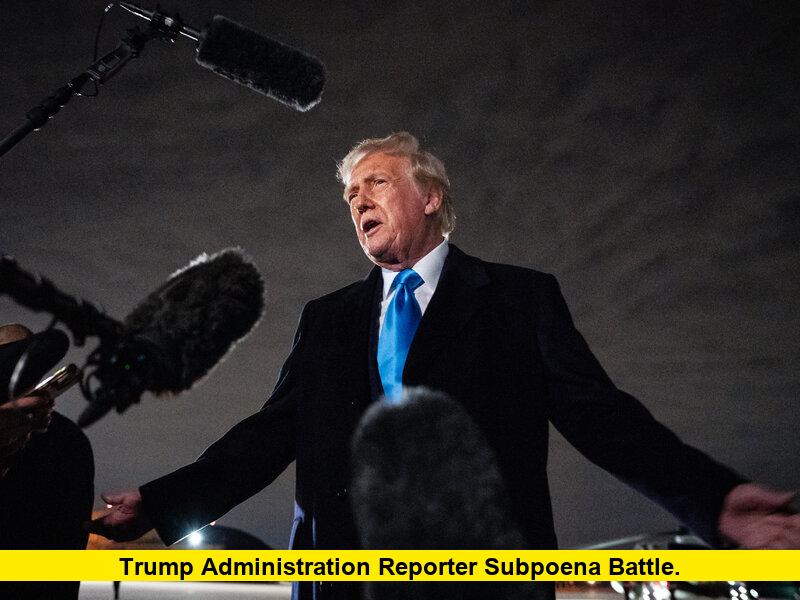
The trump administration reporter subpoena battle has become one of the most closely watched legal conflicts involving press freedom in 2026. The dispute centers on the U.S. Department of Justice’s efforts to compel several New York Times journalists to testify before a federal grand jury over reporting related to President Donald Trump’s new Air Force One.
The case has sparked nationwide debate about the balance between protecting classified information and safeguarding journalists’ First Amendment rights. As of July 23, 2026, the legal battle remains ongoing, with a federal judge considering whether the subpoenas should be enforced or dismissed.
What Is the Trump Administration Reporter Subpoena Battle?
The controversy began after The New York Times published reports describing security concerns surrounding President Trump’s Qatari-donated Boeing 747, which is intended for use as Air Force One. The newspaper reported that the aircraft reportedly lacked certain defensive systems available on the existing presidential aircraft.
Shortly after publication, federal prosecutors issued grand jury subpoenas requiring several journalists to testify regarding confidential sources connected to the reporting. The Justice Department says the investigation targets unauthorized disclosures of potentially classified information rather than the reporters themselves.
The newspaper argues that compelling journalists to reveal confidential sources threatens investigative reporting and violates long-standing constitutional protections.
Why the Justice Department Issued the Subpoenas
According to the Department of Justice, the subpoenas are part of a criminal investigation into possible leaks of classified national security information.
Government officials have stated that:
- The investigation focuses on identifying individuals responsible for unauthorized disclosures.
- The journalists themselves are not accused of criminal wrongdoing.
- National security investigations sometimes require testimony to identify the source of sensitive leaks.
The administration maintains that protecting classified defense information is essential to national security.
The New York Times’ Response
The New York Times has filed court motions asking the federal judiciary to block the subpoenas.
The newspaper argues that:
- The subpoenas were issued in bad faith.
- Forcing journalists to testify would discourage confidential sources from speaking with reporters.
- The investigation threatens freedom of the press guaranteed under the First Amendment.
Its legal team also contends that compelling reporters to reveal information gathered during newsgathering could set a significant precedent for future investigative journalism.
Federal Judge Reviews the Case
A federal judge in Manhattan has temporarily paused enforcement of the subpoenas while considering legal arguments from both sides.
During the hearing, attorneys representing the newspaper asked the court to permanently quash the subpoenas. Prosecutors requested additional time as they continue reviewing the government’s investigative strategy.
No final ruling has been issued as of July 23, 2026, leaving the future of the subpoenas uncertain.
Broader Press Freedom Concerns
Media organizations and press freedom advocates have closely followed the dispute.
Critics argue the subpoenas could:
- Discourage whistleblowers from sharing information.
- Increase government pressure on investigative journalism.
- Create uncertainty for reporters covering national security issues.
Supporters of the Justice Department’s position argue that governments have a legitimate interest in preventing unauthorized disclosure of classified information that could affect national security.
The debate highlights the continuing tension between national security investigations and constitutional protections for the press.
Connection to Earlier Reporter Subpoena Cases
The current case follows other recent disputes involving federal efforts to compel journalists to testify.
Earlier in 2026, subpoenas directed at reporters from The Washington Post and The Wall Street Journal were later withdrawn after legal challenges. Those developments drew renewed attention to Justice Department policies regarding investigations involving members of the news media.
What Happens Next?
Several developments could shape the outcome of the trump administration reporter subpoena battle:
- The federal judge could quash the subpoenas entirely.
- The court could permit limited testimony under specific conditions.
- The Justice Department could modify or withdraw the subpoenas.
- Appeals may follow regardless of the initial ruling.
Because the case involves constitutional questions about press freedom and government authority, legal experts believe it could have lasting implications for future leak investigations.
Why This Case Matters
The legal dispute extends well beyond a single news story. It raises important questions about:
- The protection of confidential journalistic sources.
- Government authority during national security investigations.
- The relationship between investigative reporting and federal law enforcement.
- Future standards governing subpoenas issued to reporters.
Regardless of the eventual outcome, the case is expected to influence discussions surrounding press freedom, government transparency, and constitutional rights for years to come.
As this closely watched legal battle continues, stay informed and share your thoughts in the comments below for the latest updates on this developing story.