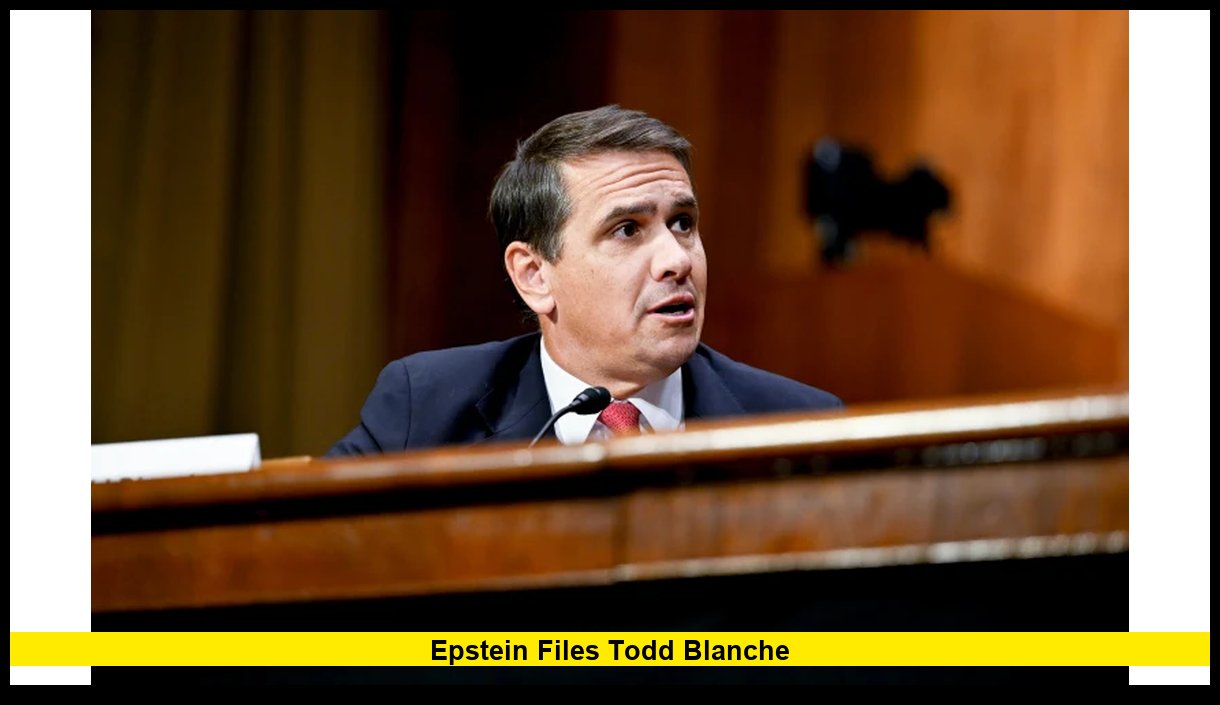
The Epstein files Todd Blanche issue has emerged as one of the most closely watched transparency debates in modern American justice, placing the U.S. Department of Justice under intense public and congressional scrutiny. As deputy attorney general, Todd Blanche has become a central figure in overseeing the release and review of long-sealed records connected to Jeffrey Epstein, the convicted sex offender whose case exposed systemic failures across law enforcement, politics, and elite institutions.
The renewed focus on these records reflects more than curiosity about past crimes. It represents a broader demand for accountability, clarity, and institutional integrity. For many Americans, the Epstein files are not simply historical documents. They are a test of whether the justice system is willing and able to confront uncomfortable truths, even when those truths involve powerful individuals or entrenched bureaucratic processes.
Why the Epstein Files Remain a National Issue
Years after Jeffrey Epstein’s death in federal custody, public interest in his case has not diminished. Instead, it has intensified. Epstein’s crimes involved the exploitation of minors, abuse of privilege, and failures across multiple layers of oversight. His wealth, connections, and access to influential circles fueled widespread concern that justice was delayed, diluted, or denied.
The Epstein files encompass investigative records, court materials, internal communications, and evidentiary documents generated over decades. Many of these materials were sealed, restricted, or never fully disclosed to the public. That lack of transparency created lingering doubts about whether all relevant facts were ever examined or whether accountability stopped short of its proper scope.
The renewed effort to review and release these records places the Department of Justice at the center of a national reckoning. It also elevates the role of senior officials tasked with balancing transparency, privacy, and the rule of law.
Todd Blanche’s Role in the Justice Department
Todd Blanche serves as deputy attorney general, the second-highest position in the Department of Justice. The role carries broad authority over federal prosecutions, internal policy decisions, and the management of complex legal disclosures. In the context of the Epstein files, Blanche’s office oversees the coordination between career prosecutors, document review teams, victim-rights specialists, and legal compliance units.
Blanche’s responsibilities include ensuring that document releases comply with federal law while protecting the rights of victims and safeguarding ongoing legal processes. This balance has proven difficult, particularly given the scale of the Epstein records and the intense public pressure for full disclosure.
His involvement has made Blanche a focal point for both supporters of the transparency effort and critics who argue that the government is moving too slowly or withholding too much information.
Scope and Complexity of the Epstein Records
The Epstein files are not a single archive or neatly organized collection. They consist of vast volumes of material generated across multiple investigations, jurisdictions, and time periods. These include:
- Investigative reports compiled by federal and local law enforcement
- Court filings, transcripts, and judicial rulings
- Evidence logs, photographs, and seized materials
- Internal communications among agencies
- Records involving victims, witnesses, and third parties
Each category presents its own legal and ethical challenges. Many documents contain sensitive personal information, including the identities of survivors who were minors at the time of abuse. Others reference individuals who were never charged with crimes. Some materials overlap with investigations that extended beyond Epstein himself.
This complexity explains why the review process has been lengthy and resource-intensive. It also underscores why the Department of Justice has approached disclosure in stages rather than releasing all records simultaneously.
Legal Framework Governing Disclosure
Federal law imposes strict requirements on how investigative and prosecutorial records may be released. Even when transparency is mandated, agencies must comply with privacy protections, victim-rights statutes, and due-process considerations.
Under these rules, the Justice Department cannot simply publish every document in its possession without review. Names may need to be redacted. Certain evidentiary materials may require contextual explanation. Documents related to sealed proceedings or protected witnesses demand special handling.
Todd Blanche’s office has emphasized that these legal obligations are not optional. Failure to follow them could retraumatize survivors, violate court orders, or compromise legal standards that apply to all federal cases, not only those involving Epstein.
Public Expectations Versus Institutional Limits
Despite these constraints, public expectations remain high. Many Americans believe that Epstein’s case represents a unique failure so severe that it justifies extraordinary transparency. The argument is simple: if secrecy contributed to injustice in the past, openness is the only path to restoring trust.
Critics of the Justice Department’s pace argue that delays and redactions risk repeating the very mistakes that allowed Epstein to evade accountability for years. They contend that the public deserves to see how decisions were made, who knew what, and when warnings went unheeded.
Supporters of the DOJ’s approach counter that responsible disclosure takes time and precision. They warn that reckless releases could distort facts, unfairly damage reputations, or expose victims to renewed harm.
Todd Blanche stands at the center of this debate, tasked with navigating competing demands that rarely align neatly.
Victim Protection as a Central Priority
One of the most sensitive aspects of the Epstein files involves survivors of abuse. Many victims were minors when the crimes occurred, and some have spent years rebuilding their lives away from public attention. Federal law requires that their identities and personal details be protected, even in high-profile disclosures.
The Justice Department has emphasized that victim protection is not a procedural afterthought. It is a legal and moral obligation. Document review teams work line by line to remove information that could reveal identities or retraumatize survivors.
This process significantly slows the pace of disclosure, but it reflects a broader shift in how the justice system treats victims of sexual exploitation. In the Epstein case, that shift carries particular weight, given the long history of survivors feeling ignored or marginalized.
Political and Congressional Scrutiny
The Epstein files Todd Blanche issue has also drawn sustained attention from lawmakers. Members of Congress from across the political spectrum have pressed the Justice Department for greater clarity about what will be released, when, and under what standards.
Some lawmakers argue that legislative intent favors maximum disclosure and that administrative caution has gone too far. Others acknowledge the complexity of the task but demand clearer timelines and explanations for redactions.
Congressional oversight has included formal inquiries, public statements, and calls for detailed reporting from the Justice Department. These pressures add another layer of accountability to Blanche’s role and reinforce the national importance of the issue.
Media Coverage and Public Discourse
Media attention surrounding the Epstein files has been intense and persistent. News organizations, legal analysts, and advocacy groups continue to examine every development for signs of progress or obstruction. Public discussion spans traditional media, online forums, and social platforms.
This environment amplifies both facts and misconceptions. Names mentioned in documents can quickly become the subject of speculation, even when no wrongdoing is alleged. That reality heightens the stakes for careful, accurate disclosure.
The Justice Department has sought to counter misinformation by emphasizing that the presence of a name in a record does not imply criminal conduct. Still, the challenge remains significant in a media landscape driven by speed and sensationalism.
The Broader Impact on Trust in Institutions
At its core, the Epstein files debate is about trust. Trust in law enforcement. Trust in prosecutors. Trust in institutions that claim to serve the public interest.
Failures in the Epstein case damaged that trust deeply. Many Americans view the current disclosure process as an opportunity to either rebuild confidence or confirm longstanding doubts. The outcome will influence how future cases involving powerful defendants are perceived.
Todd Blanche’s stewardship of this process places him in a position that extends beyond administrative duty. His decisions will shape how the Justice Department is judged not only in this case, but in its broader commitment to transparency and accountability.
Balancing Accountability and Fairness
Another critical dimension involves fairness to individuals named in the records. Not everyone who crossed paths with Epstein committed crimes. Some were witnesses. Others were tangential contacts. Some appear in documents simply because they were mentioned, not because they were investigated.
The Justice Department must balance the public’s right to know with the principle that individuals should not be judged by association alone. This balance is difficult but essential to maintaining the credibility of the legal system.
Todd Blanche has underscored that accountability must be rooted in evidence and due process, not inference or public pressure.
Ongoing Review and Future Releases
The review of Epstein-related materials remains ongoing. Additional records continue to be examined, categorized, and prepared for release where legally permissible. Each phase of disclosure brings renewed attention and renewed debate.
Future releases may clarify unanswered questions, confirm known facts, or reveal institutional shortcomings that demand reform. They may also reinforce the limits of what documents alone can explain.
The Justice Department has signaled that transparency will continue, though always within the bounds of law and victim protection.
Why This Moment Matters
The Epstein files Todd Blanche controversy arrives at a time when public confidence in institutions is fragile. Americans are increasingly skeptical of secrecy, particularly when it surrounds cases involving wealth and power.
How the Justice Department handles these records will resonate beyond the Epstein case. It will influence expectations for transparency in future investigations and shape public understanding of justice in complex, politically sensitive matters.
The stakes are high, not because of curiosity alone, but because accountability is a cornerstone of democratic governance.
A Defining Test for the Justice Department
For Todd Blanche, the Epstein files represent one of the most challenging responsibilities of his tenure. The task requires legal precision, moral clarity, and resilience under scrutiny. It demands respect for victims, fairness to individuals, and openness to public concern.
The outcome will not satisfy everyone. No disclosure process of this magnitude ever does. But the way it is conducted will define how history judges this chapter of American justice.
As the review continues, the nation watches closely, and the conversation around transparency, accountability, and trust remains far from over.