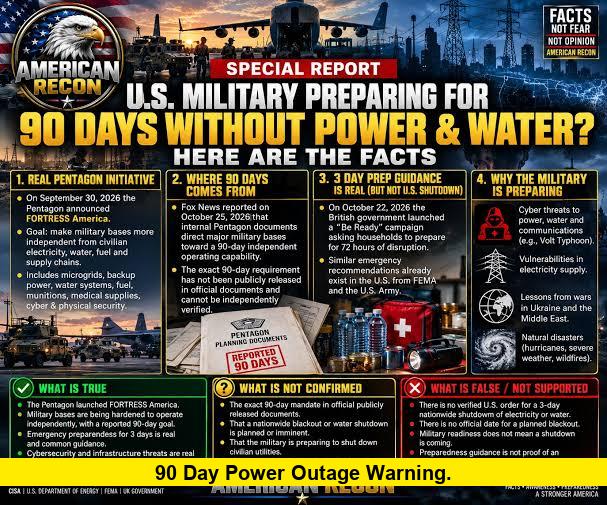
If you searched 90 day power outage warning when does it start, the short answer is that no start date exists. No federal agency, utility or grid operator has announced a 90-day blackout for American homes. The viral claim traces back to a Pentagon plan for military bases, not a forecast for the public.
The confusion peaked in early November 2026. Social media posts began presenting a defense initiative as a countdown to a nationwide shutdown. Here is what is confirmed, what is still unclear, and how to prepare for the outages that actually happen.
Where the 90-Day Figure Comes From
On September 30, 2026, Defense Secretary Pete Hegseth unveiled an initiative called FORTRESS America during a State of the Force address at Marine Corps Base Quantico in Virginia. The Pentagon published details of the six initiatives announced that day. FORTRESS aims to make major military installations less dependent on civilian power, water, fuel and supply chains.
The 90-day number arrived later. On October 25, 2026, Fox News Digital reported on internal documents describing a goal for major continental U.S. bases to keep essential operations running for at least 90 days without outside support. Pentagon spokesman Sean Parnell told the outlet, “Power is combat now.”
Several outlets noted that it was unclear whether the Pentagon had formally confirmed the 90-day target as a fixed requirement. The standard is best understood as a planning goal, not proof that every base can already operate that long.
So, When Does the 90-Day Blackout Start?
It does not start, because nobody has scheduled one. As of November 14, 2026, no official source has announced a planned shutdown of the civilian grid for 90 days or any other length.
The FORTRESS plan describes how military bases could keep working if a war, cyberattack or disaster cut them off. That differs from a warning that households will lose electricity. A contingency plan is not a prediction.
Fact-checkers have also flagged videos that claim to show President Trump announcing a 90-day blackout. Snopes reportedly identified those clips as AI-generated fakes on November 10, 2026. Anyone who sees such a video should check it against official sources before sharing.
What FORTRESS America Would Actually Change
Reporting on the initiative describes several steps for military installations:
- Independent power: Microgrids and large battery storage that can separate from the civilian grid.
- Advanced energy options: Portable nuclear reactors were also reported as a possibility.
- Reserves: Stockpiles of fuel, medical supplies, electronics and other essential materials.
- Supply chain planning: Assessments of which manufacturers could support a crisis.
Hegseth’s memo set a deadline for a dedicated FORTRESS office, and Fox News reported it should be established by October 30, 2026. No programwide completion date has been announced, so the timeline for finishing the work remains uncertain.
Why the Rumor Spread So Quickly
Three factors fueled the panic. First, the “90 days” language sounds like a countdown. Second, commentators contrasted the Pentagon’s approach with official guidance in the United Kingdom, where families were told to keep supplies for a few days of disruption. Third, expert interviews on cable news discussed worst-case grid-down scenarios, including attacks on infrastructure.
Those discussions describe risks and possibilities. They do not describe an event that officials expect to happen.
How Reliable Is the U.S. Power Grid This Winter?
A 90-day blackout is not forecast, but the grid does face real strain. Electricity demand is rising, driven partly by data centers, electrification and new manufacturing.
The North American Electric Reliability Corporation (NERC) said in its 2025–2026 Winter Reliability Assessment that peak demand rose by about 20.2 gigawatts, or 2.5%, over the prior winter. Resources grew by only about 9.4 gigawatts. NERC found that all areas had adequate resources for expected peak demand. It also warned that widespread extreme cold could cause supply shortfalls, with elevated risk in parts of New England, the Southeast, Texas and the West.
Winter Storms Fern and Gianna tested the system in early 2026. A joint review by the Federal Energy Regulatory Commission and NERC, released on September 10, 2026, concluded that preparation helped but that the margin for error can narrow quickly. NERC also reported that 99% of winter generating capacity could operate in extreme cold last winter.
You can follow the latest reliability findings on the NERC website.
What Long Outages Look Like in Real Life
Most U.S. outages last hours or a few days, usually after storms, heat waves or equipment failures. Multi-week outages are rare and typically follow catastrophic events.
The most extreme recent example was Puerto Rico after Hurricane Maria in 2017. FEMA reported that the island’s entire grid failed, and roughly 65% of customers had power back after 90 days. That case involved a devastating hurricane and an island grid, so it is not a model for a mainland blackout.
Where a Real Outage Warning Would Come From
A planned outage affecting your home would not appear first in a viral video. Check these sources:
- Your electric utility: Outage maps, text alerts and customer notices.
- Your local emergency management office: County and city alerts.
- Your grid operator: Regional operators issue emergency conservation alerts during supply shortages.
- Wireless Emergency Alerts: Government alerts sent to your phone.
How to Prepare for a Power Outage Without Panic
Federal guidance focuses on practical readiness rather than 90-day stockpiles. Ready.gov offers a detailed power outage guide covering food safety, medical devices and communication. Official advice commonly centers on at least 72 hours of supplies, and many agencies encourage building toward two weeks.
A sensible home plan includes the following:
- Water: Store about 1 gallon per person per day, plus extra for pets.
- Food: Keep shelf-stable items that need little or no cooking.
- Light and power: Stock flashlights, batteries and fully charged power banks.
- Medicine: Keep at least a week of essential prescriptions on hand, and ask your pharmacist about refrigerated medications.
- Medical equipment: Arrange backup power or a plan with your provider if you rely on powered devices.
- Heat and cooling: Know a warm or cool place to go, such as a friend’s home or a community shelter.
- Communication: Keep a battery-powered or hand-crank radio and paper copies of key phone numbers.
Safety Rules That Matter Most
Never run a generator indoors, in a garage or near windows. Carbon monoxide poisoning is among the most serious risks during outages. Keep portable generators outside and well away from your home, and install battery-powered carbon monoxide detectors.
Do not use grills, camp stoves or propane heaters indoors for heating. When the power returns, avoid food that sat above safe temperatures for too long.
What to Watch Next
Several developments could bring clarity in the coming weeks:
- FORTRESS updates: The Pentagon could publish timelines, costs or formal requirements for the 90-day goal.
- Winter weather: Extreme cold remains the most realistic threat to grid reliability this season.
- Grid reliability reports: NERC and regional operators issue seasonal warnings and post-event reviews.
- Official alerts: Real warnings will come through utilities and emergency agencies.
Treat unverified claims about a countdown or start date with caution. If a source cannot name an agency, a date and an official document, it is probably rumor.
The Bottom Line
The 90-day figure is real, but it applies to military base resilience, not household electricity. Preparing for a few days to two weeks without power is practical and worthwhile. A 90-day blackout is not forecast.
Have you prepared for a winter outage, or did the 90-day rumor catch your attention? Share your thoughts in the comments and check back for the latest verified updates.