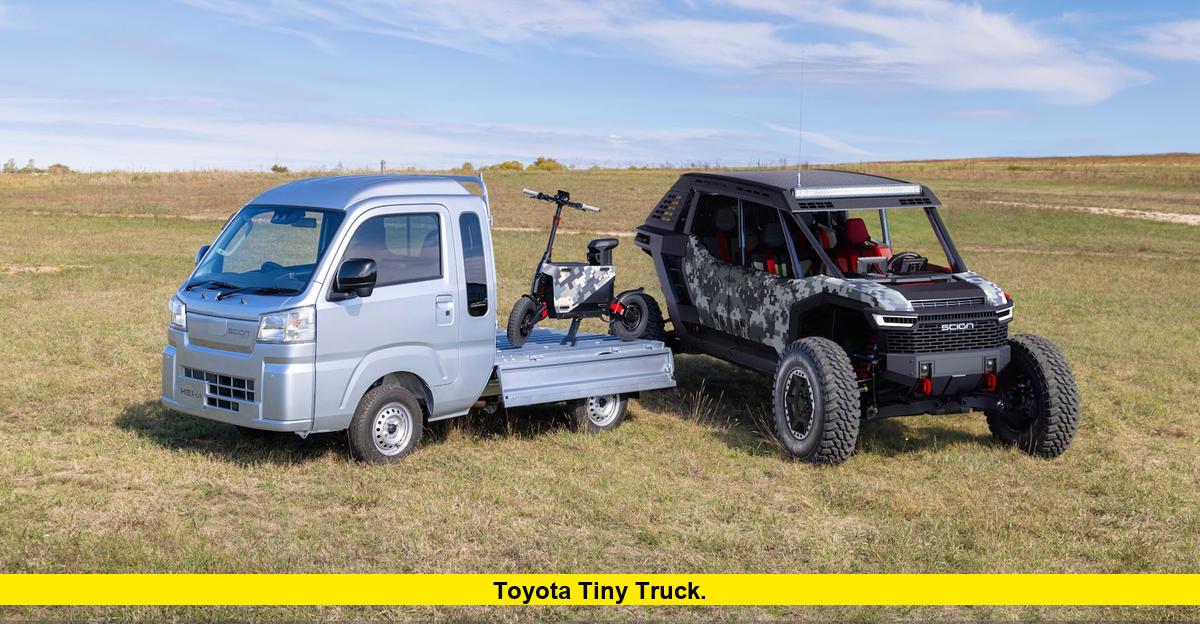
Toyota is bringing a genuine tiny truck to the United States. On November 10, 2026, the company announced the Scion by Toyota KEI-01, an ultra-compact utility pickup modeled on Japan’s popular kei trucks. It will be assembled in Indiana and aimed first at fleet customers starting in the second half of 2027.
The move revives the Scion name as a “freedom lab” for new mobility ideas. The KEI-01 is not a full-speed pickup like the Tacoma. It is a right-hand-drive, low-speed vehicle designed for tight spaces, light work, and controlled routes.
What Is the Toyota Tiny Truck?
The KEI-01 is Toyota’s adaptation of the Daihatsu Hijet Jumbo / Toyota Pixis formula that has long been a workhorse in Japan. It measures just over 11 feet long and under 5 feet wide, making it far smaller than any current U.S. pickup or even a compact car. Toyota positions it as an affordable, highly maneuverable tool for jobs where a full-size truck is unnecessary or impractical.
It is the first vehicle under the new Scion by Toyota brand, introduced at events in Michigan and Texas. Toyota describes the brand as a place to explore bold ideas in mobility, utility, and adventure beyond its mainstream lineup.
Key Specs and Features of the KEI-01
The truck comes standard with a 660cc three-cylinder engine, a continuously variable transmission, and selectable four-wheel drive with an automatic mode and push-button lock for mud, snow, or uneven ground. Its factory top speed is limited to 25 mph.
Payload capacity reaches up to 600 pounds in a three-way fold-down cargo bed that lowers for easier loading. The extended cab includes a raised roofline, reclining and sliding seats, interior storage, and standard heat and air conditioning. It also has the structural capability to tow small trailers and equipment, though Toyota has not released an official tow rating.
Additional details from Toyota’s announcement include a reverse camera and the basic equipment needed to meet low-speed vehicle rules. No official horsepower, fuel economy, or curb weight figures have been published yet. Some reports note it weighs under 2,000 pounds.
Production at Toyota’s Indiana Plant
Assembly will take place at Toyota Motor Manufacturing Indiana in Princeton, beginning in the second half of 2027. Toyota is investing $34 million to set up new vehicle assembly operations and upgrade production and logistics infrastructure. The project is expected to create approximately 50 jobs.
This fits Toyota’s long-standing U.S. manufacturing presence. The Princeton plant already builds models such as the Highlander, Grand Highlander, Sienna Hybrid, and Lexus TX. The modest investment signals a cautious, low-volume pilot rather than a mass-market truck launch.
Availability, Pricing, and Who Can Buy the Toyota Tiny Truck
Initial sales will focus on a fleet pilot program through a small network of authorized Scion by Toyota dealers selected from the existing Toyota dealer network. Target users include small business owners, farmers and ranchers, municipalities, universities, corporate campuses, urban delivery services, and outdoor enthusiasts who need a compact work vehicle for short, controlled routes.
Toyota has not announced pricing. It describes the KEI-01 as affordable but has given no figures or sales targets. The company says it may consider limited retail sales later, depending on customer demand, market conditions, and operational factors. More details on the sales strategy are expected closer to launch.
Why the 25 MPH Limit and Right-Hand Drive?
The KEI-01 is engineered to meet Federal Motor Vehicle Safety Standard No. 500 for low-speed vehicles (LSVs). Under these rules, a vehicle’s maximum speed attainable in one mile cannot exceed 25 mph, and it must include basic safety equipment such as lights, mirrors, a windshield, seat belts, and a VIN. This classification allows Toyota to offer the truck without meeting the full crash-test and safety standards required for conventional passenger vehicles or pickups. It also permits the right-hand-drive layout common to Japanese kei trucks.
Because it is an LSV, its use on public roads will generally be limited to streets posted at 35 mph or less, though exact rules vary by state. It is not intended for highways or high-speed roads. Buyers and fleet managers should check local regulations before planning routes.
For the official low-speed vehicle requirements, see the eCFR text of FMVSS No. 500.
What the Toyota Tiny Truck Means for U.S. Buyers and Fleets
For many small operators, the KEI-01 could fill a gap between golf carts, side-by-sides, and full-size trucks. Its tiny footprint helps in dense yards, campuses, farms, and urban delivery routes where maneuverability and low operating costs matter more than highway speed. Selectable 4WD and a useful payload add capability that basic low-speed vehicles often lack.
It is not a replacement for a Tacoma or other conventional pickups. The 25 mph cap, right-hand drive, and initial fleet-only availability make it a niche product. Enthusiasts who want a full-speed kei truck for broader road use currently rely on 25-year-old imports, which face different state-by-state rules.
Toyota’s decision also reflects interest in smaller, more affordable options amid high vehicle prices. Reporting has noted encouragement from President Donald Trump for Japanese-style kei vehicles, with a preference for domestic assembly. Toyota has not confirmed a direct link but is building the truck in Indiana.
Official details are available in Toyota’s Scion by Toyota and KEI-01 announcement and Reuters coverage of the U.S. rollout.
What Readers Should Watch Next
Pricing, the list of participating dealers, and confirmation of any retail pathway remain the biggest open questions. Production timing points to vehicles reaching customers in late 2027 or shortly after. Fleet feedback during the pilot will likely shape whether limited consumer sales follow.
Watch for updates on exact specifications, warranty coverage, and how states apply LSV rules to this new model. Toyota’s broader Scion by Toyota concepts (including side-by-side and personal mobility ideas) may also reveal more about the brand’s direction.
The Toyota tiny truck arrives as a practical experiment rather than a mass-market contender. For the right users—those who need a tough, compact work tool on low-speed routes—it could prove useful once details solidify.
Would a 25 mph Toyota tiny truck actually fit your farm, campus, or delivery needs—or is the speed limit a deal-breaker? Share your thoughts below and stay tuned for pricing and dealer updates.