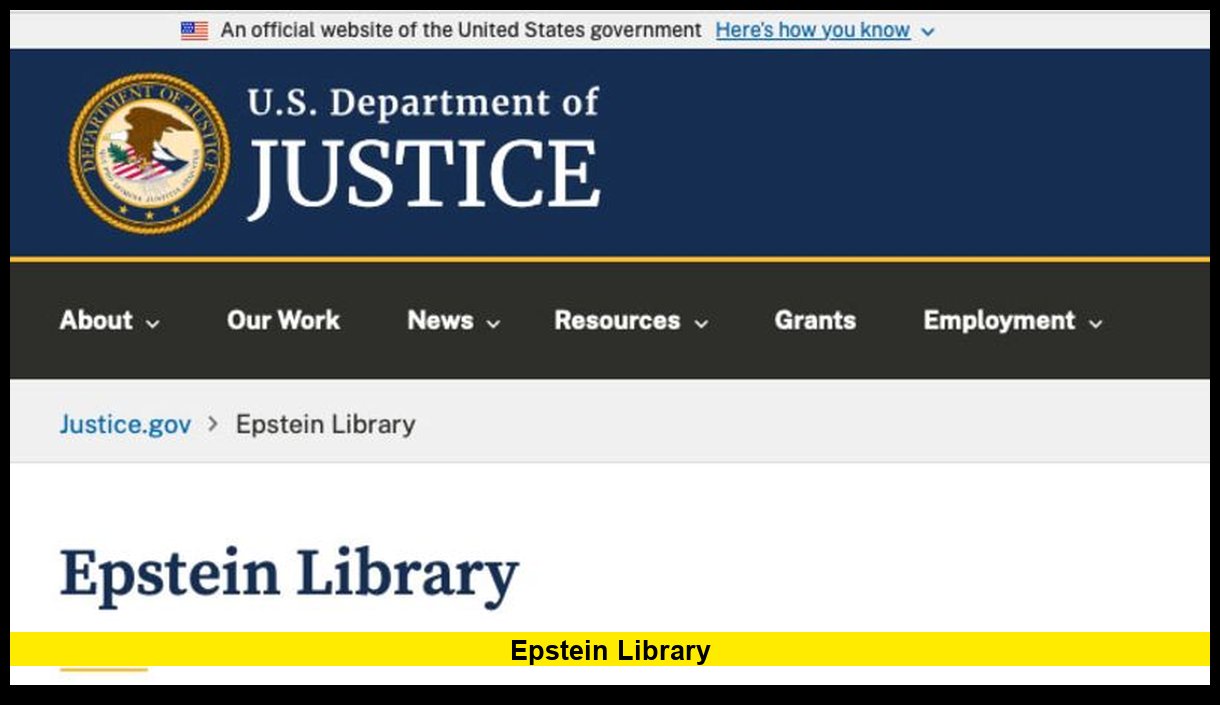
The “Epstein Library” is the U.S. Department of Justice’s growing public archive that releases and organizes records, court filings, and investigative documents related to convicted sex offender Jeffrey Epstein and associated cases.
The Epstein Library became publicly accessible in December 2025 as the U.S. Department of Justice released a centralized digital archive of government records connected to Jeffrey Epstein. The library now serves as a searchable public database that consolidates thousands of documents previously scattered across courts, agencies, and congressional disclosures. Its launch marked a major moment in federal transparency efforts tied to one of the most scrutinized criminal cases in modern U.S. history.
The release followed the federal mandate requiring disclosure of unclassified Epstein-related materials. As of today, the Epstein Library continues to expand as records are reviewed, processed, and uploaded. The archive reflects the government’s current position on balancing public access with legal protections, especially for victims and sensitive investigative material.
What the Epstein Library Is and Why It Exists
The Epstein Library is an official online repository maintained by the U.S. Department of Justice (DOJ) that centralizes records connected to the investigations, prosecutions, and related legal proceedings involving Jeffrey Epstein. The archive was created following passage of the Epstein Files Transparency Act, legislation requiring federal authorities to make a vast collection of Epstein-related records available to the public while protecting victim identities and other legally sensitive information.
Before the library was established, Epstein-related documents were scattered across federal court dockets, congressional investigations, Freedom of Information Act disclosures, and various government agencies. As a result, journalists, researchers, survivors, and members of the public often faced significant challenges locating and reviewing records. The DOJ launched the Epstein Library to consolidate these materials into a single searchable platform, making access to previously released records more efficient and transparent.
The archive is intended as a document repository rather than an investigative report. It does not provide commentary, conclusions, or interpretations of the material. Instead, it presents records as maintained by government agencies, with redactions applied where required by law to protect victims, privacy interests, ongoing legal matters, and privileged information.
Latest Developments in 2026
The Epstein Library has expanded significantly during 2026. On January 30, the DOJ announced the publication of more than 3 million additional pages of records, along with over 180,000 images and 2,000 videos. According to the department, the release brought the total amount of publicly available material to nearly 3.5 million pages and was intended to satisfy the transparency requirements established by Congress.
However, the release has generated substantial controversy. Critics, including lawmakers, victim advocates, and legal experts, argued that millions of potentially relevant records may still remain unavailable and questioned whether the government had fully complied with the law. Some members of Congress have challenged the DOJ’s decision-making process regarding what was deemed responsive and what was withheld.
Another major issue involved redaction errors. Shortly after the large January release, the DOJ acknowledged that some files inadvertently exposed sensitive personal information belonging to Epstein survivors. Thousands of documents were temporarily removed and reviewed after concerns were raised by victims and their attorneys. The department subsequently revised its review procedures and implemented additional safeguards for future disclosures.
The handling of the records has also attracted political scrutiny. In April 2026, the DOJ’s Office of the Inspector General launched an audit examining whether the department properly identified, reviewed, redacted, and released Epstein-related materials under the transparency law. The audit remains ongoing and is expected to evaluate both the release process and the government’s response to complaints about privacy violations and withheld records.
Most recently, congressional investigators continued examining the DOJ’s management of the Epstein files. Testimony and released transcripts from former Attorney General Pam Bondi renewed debate over who supervised the document-review process and whether the department’s disclosures met public expectations for transparency.
As of June 2026, the Epstein Library remains one of the largest public document archives ever assembled around a federal criminal investigation. While supporters view it as a significant transparency initiative, critics argue that questions about redactions, missing records, victim protections, and overall compliance with disclosure requirements have yet to be fully resolved.
How the Epstein Library Is Structured
Given the unprecedented scale of the records released, the Epstein Library was designed with a category-based structure that allows users to navigate millions of pages of documents more efficiently. The archive separates records according to their origin, legal context, and method of disclosure, helping researchers, journalists, legal analysts, and members of the public trace how information about Jeffrey Epstein moved through different branches of government over time.
Court Records Section
One of the most heavily accessed portions of the archive is the Court Records section. This area contains documents generated through federal and state judicial proceedings connected to Epstein and related cases. Users can review indictments, motions, judicial rulings, hearing transcripts, plea agreements, sentencing records, and other filings that formed the legal foundation of the government’s cases.
Although many of these records were already public before the creation of the library, they were often dispersed across multiple court systems and databases. By consolidating them into a single location, the archive provides a clearer picture of how prosecutors pursued charges, how defense teams responded, and how courts ruled on key legal questions throughout the various proceedings.
Most court documents appear with legally mandated redactions. Names and identifying details of victims, witnesses, and private individuals are commonly removed to comply with federal privacy protections and court orders.
Department of Justice Disclosures
The Department of Justice Disclosures section represents one of the largest and most significant components of the Epstein Library. This category includes investigative materials, internal memoranda, correspondence, administrative records, case summaries, and other documents produced by federal law enforcement agencies during the course of their work.
Following the major document releases of 2026, this section expanded dramatically, adding millions of pages of records from multiple federal agencies. The disclosures provide insight into how investigators coordinated inquiries, reviewed evidence, managed case files, and handled procedural matters over several years.
Because these records often contain sensitive law-enforcement information, many documents include redactions designed to protect investigative techniques, confidential sources, personal privacy, and information that may still be subject to legal restrictions. Despite those limitations, the DOJ disclosures offer one of the most detailed views yet of the federal government’s handling of the Epstein investigations.
Freedom of Information Act Records
Another major category contains records previously released through Freedom of Information Act (FOIA) requests. Long before the establishment of the Epstein Library, journalists, advocacy groups, researchers, and private citizens sought access to government records concerning Epstein through the federal FOIA process.
These documents often overlap with records found elsewhere in the archive, but their inclusion serves an important historical purpose. The FOIA section documents how information entered the public domain over time and highlights the role transparency laws played in revealing details about government investigations.
In many cases, users can compare earlier FOIA releases with newer disclosures to understand how the public record evolved and how additional information became available through subsequent investigations and legal proceedings.
Congressional Disclosures
The Congressional Disclosures section focuses on records released through legislative oversight activities. As public interest in Epstein’s case grew, congressional committees launched investigations examining the actions of federal agencies, prosecutorial decisions, and broader issues involving accountability and transparency.
This portion of the library includes hearing materials, committee records, investigative exhibits, correspondence, subpoenaed documents, and records obtained from third parties, including materials connected to Epstein’s estate and associated organizations. These disclosures provide insight into how lawmakers evaluated government responses and sought answers regarding past investigative decisions.
By preserving congressional records alongside judicial and executive-branch documents, the archive creates a more comprehensive historical record of how multiple branches of government examined Epstein-related matters.
Additional Digital Collections and New Releases
As the archive continues to grow, newer releases have expanded beyond traditional paper records. Recent additions include large collections of digitized photographs, scanned evidence files, audio materials, and video records released under federal transparency requirements. The Department of Justice has indicated that additional material may be added as reviews and redaction processes are completed.
This ongoing expansion reflects the library’s broader mission: to serve as a centralized repository for official Epstein-related records while maintaining compliance with privacy protections and legal obligations. Although debates continue regarding withheld information and redaction policies, the archive remains the most comprehensive public collection of government records connected to the Epstein investigations and related oversight efforts.
Redactions and Content Controls
A defining feature of the Epstein Library is its extensive use of redactions and content-control measures designed to balance public transparency with legal and privacy obligations. Because many of the records involve victims of sexual abuse, witnesses, law-enforcement personnel, and private individuals, federal agencies are required to remove certain information before documents can be released to the public.
Throughout the archive, redactions are clearly marked rather than silently deleted. This approach allows users to see where information has been withheld while preserving the integrity of the original record. In most cases, redactions are applied to names, contact information, personal identifiers, medical details, victim-related information, and other content protected by federal law, court orders, or privacy regulations.
The library’s multimedia collections follow similar standards. Audio recordings that contain protected information may include masking tones or muted segments where names or identifying details have been removed. Video and photographic materials can contain blurred faces, obscured text, or digitally blocked sections intended to prevent the identification of victims and other protected individuals. These measures are consistent with longstanding federal disclosure practices and are designed to minimize the risk of harm while still making the underlying records publicly accessible.
Increased Scrutiny Following Recent Releases
The issue of redactions has received heightened attention since the Department of Justice significantly expanded the archive in 2026. While transparency advocates welcomed the release of millions of additional pages of records, questions quickly emerged about whether some redactions were too broad and whether other documents had been withheld entirely.
At the same time, government officials faced criticism from the opposite direction after several released records reportedly contained insufficiently redacted information. Following complaints from victims and their legal representatives, thousands of documents were temporarily removed for review after concerns that identifying details may have been inadvertently disclosed. The incident prompted the Justice Department to conduct additional audits and strengthen its review procedures before publishing future releases.
Balancing Transparency and Privacy
Supporters of the library argue that redactions are essential to protecting survivors and ensuring compliance with federal privacy laws. They note that unrestricted publication of investigative files could expose sensitive personal information and discourage victims from cooperating with future investigations.
Critics, however, contend that extensive redactions can make it difficult to fully understand government actions and decision-making. Some transparency advocates and lawmakers have called for greater explanations regarding why specific information is withheld, particularly in records related to prosecutorial decisions and investigative oversight.
Federal officials maintain that the archive represents the broadest disclosure legally possible under existing statutes and court directives. According to the Department of Justice, the goal is to provide maximum public access while safeguarding individuals whose rights and safety could be affected by unrestricted disclosure.
As the Epstein Library continues to expand, debates over redactions are likely to remain central to discussions about transparency, accountability, and privacy. For many observers, the challenge is not simply releasing records, but determining how much information can be disclosed without compromising legal protections for victims and other individuals connected to the case.
Public Access and Search Capabilities
The Epstein Library was built to make a massive volume of government records more accessible to the public through a centralized digital platform. Given the archive’s millions of pages of documents, thousands of multimedia files, and records from multiple government sources, search and navigation tools play a critical role in helping users locate specific information.
Visitors can explore the archive using keyword searches, document filters, and category-based browsing. Records may be sorted by publication date, document type, originating agency, or subject matter, allowing researchers to narrow searches and identify relevant materials more efficiently. This structure is particularly important because the archive combines court filings, investigative records, congressional disclosures, Freedom of Information Act releases, and multimedia evidence collections in a single repository.
Search Limitations and Document Quality
While many records are fully searchable through text-recognition technology, not every document can be indexed with the same level of accuracy. Older files, scanned paper records, handwritten notes, photocopies, and image-based documents may contain limited or imperfect text recognition. As a result, users sometimes need to manually review files rather than relying solely on keyword searches.
The challenge is especially significant in large investigative collections where historical records originated from multiple agencies using different record-keeping systems. Some documents may also contain redactions that affect searchability, particularly when names or identifying information have been removed under privacy protections.
To address these issues, the Department of Justice has continued refining indexing systems, metadata tagging, and search functionality as additional records are added to the archive.
Heavy Public Interest and Technical Challenges
Since the major expansion of the library in 2026, public interest has remained exceptionally high. Journalists, legal researchers, historians, advocacy organizations, and members of the public have generated significant traffic as new records became available.
The increased demand has occasionally affected loading times, search performance, and download speeds. Federal officials have acknowledged these challenges and stated that technical upgrades are being implemented to improve stability, indexing accuracy, and user experience. Ongoing improvements include server-capacity enhancements, expanded search tools, and better document categorization intended to help users navigate the growing archive more effectively.
A Historic Digital Archive
Despite occasional technical limitations and the challenges associated with managing millions of records, the Epstein Library represents the most comprehensive public repository of Epstein-related federal documents ever assembled. By bringing together court filings, investigative records, congressional materials, FOIA disclosures, photographs, videos, and other government documents in one searchable location, the archive has transformed how the public can access and examine information connected to the case.
As additional records are reviewed and released, the library is expected to remain a central resource for understanding the legal proceedings, investigative history, and government oversight efforts surrounding Jeffrey Epstein. For supporters, it stands as one of the most significant transparency initiatives in recent federal history; for critics, it remains a work in progress whose effectiveness will ultimately be judged by the completeness and accessibility of the records it provides.
Why the Epstein Library Draws National Attention
The Epstein Library has attracted significant national and international attention because the case involving Jeffrey Epstein remains one of the most scrutinized criminal matters in modern American history. Beyond the crimes themselves, the case has generated years of public debate about prosecutorial decisions, law-enforcement oversight, institutional accountability, and the treatment of allegations involving powerful individuals. Many of those questions continue to be discussed long after Epstein’s death, making the release of official records a matter of ongoing public interest.
The library does not seek to answer those questions or provide official conclusions. Instead, it serves as a repository of source material that allows the public to examine government records firsthand. By making court filings, investigative documents, congressional records, and administrative materials available in one location, the archive gives researchers and citizens direct access to the documentary record rather than relying solely on media reports or secondary interpretations.
A Resource for Journalists and Researchers
Since its launch, the Epstein Library has become an important resource for investigative journalists, legal scholars, historians, transparency advocates, and public-interest organizations. Reporters have used the archive to trace timelines, verify facts, and examine how different agencies handled various stages of the investigations. Legal analysts have reviewed court filings and prosecutorial records to better understand the legal decisions that shaped the case.
Researchers studying government transparency and institutional accountability have also turned to the archive as a unique case study. Because the library combines records from the judicial, executive, and legislative branches, it provides a rare opportunity to examine how multiple parts of government responded to a high-profile criminal investigation over an extended period.
Ongoing Public Debate
The archive’s significance extends beyond the documents themselves. For many observers, the Epstein Library represents an effort to address long-standing demands for greater transparency regarding how federal authorities investigated, prosecuted, and monitored Epstein. Supporters view the archive as a landmark disclosure initiative that expands public access to government records on an unprecedented scale.
At the same time, debates continue over the completeness of the releases, the scope of redactions, and whether additional records should be made public. Questions surrounding withheld documents, privacy protections, and the balance between transparency and legal obligations remain central to discussions about the archive’s effectiveness.
A Broader Shift Toward Transparency
The creation of the Epstein Library reflects a broader movement toward mandated disclosure and public access in major federal cases. In recent years, lawmakers and advocacy groups have increasingly pushed for centralized archives and structured document releases in matters involving significant public interest. The goal is to improve accountability by allowing citizens to review primary-source records rather than relying exclusively on summaries produced by government agencies or outside organizations.
As a result, the Epstein Library has become more than a repository of records tied to a single case. It is also viewed as a test of how federal institutions handle transparency in the digital age. Whether praised as a breakthrough in public access or criticized as an incomplete disclosure effort, the archive has established itself as a major reference point in ongoing conversations about government accountability, public oversight, and access to information.
Political and Legal Reactions
The launch and expansion of the Epstein Library have generated strong reactions from lawmakers, legal experts, transparency advocates, and victim-rights organizations. Because the archive sits at the intersection of public accountability, privacy protections, and government transparency, it has become a focal point for broader debates about how federal agencies should handle records in high-profile criminal cases.
Members of Congress from both major political parties have generally supported the idea of a centralized archive, describing it as an important step toward improving public access to government records. Supporters argue that bringing millions of pages of documents together in a single searchable repository helps eliminate confusion, reduces reliance on scattered disclosures, and allows the public to review official records more directly.
At the same time, some lawmakers have questioned whether the releases fully meet the spirit of the transparency legislation that led to the archive’s creation. Critics have raised concerns about the volume of redactions, the pace of document releases, and reports that certain categories of records may remain unavailable. Several congressional committees have sought additional explanations from federal officials regarding how decisions were made about what information could be disclosed and what had to remain protected under existing laws.
Legal Perspectives on Disclosure
Legal experts have offered differing assessments of the archive. Some view the library as an unprecedented transparency initiative that provides public access to an extraordinary amount of government information while respecting legal obligations to protect victims and sensitive investigative details.
Others argue that extensive redactions can make it difficult to fully evaluate government actions or understand the context surrounding specific decisions. In their view, transparency is most effective when records are released with sufficient detail to allow meaningful public review. However, many legal scholars acknowledge that federal agencies must operate within a framework of privacy laws, court orders, victim-protection statutes, and evidentiary restrictions that limit what can legally be disclosed.
The debate has become even more prominent following the large-scale releases made during 2026, which prompted renewed scrutiny of both the disclosure process and the handling of sensitive information. Ongoing reviews and oversight efforts have focused on whether the government struck the appropriate balance between openness and privacy protection.
Transparency Versus Legal Constraints
At the center of the discussion is a fundamental tension that affects many high-profile government disclosures: the public’s demand for transparency versus the legal requirement to safeguard protected information. Advocates for broader disclosure contend that greater access promotes accountability and public confidence in government institutions. Privacy advocates and victim-rights groups emphasize that transparency should not come at the expense of individual safety, dignity, or legal rights.
Federal officials maintain that the Epstein Library was designed to provide the maximum level of disclosure permitted under current law. According to that view, redactions and withheld information are not intended to obscure the record but rather to comply with legal obligations that apply to all federal disclosures involving sensitive personal information and criminal investigations.
Continuing Debate Over Future Releases
Although the archive has already become the largest public collection of Epstein-related government records, discussion continues about whether additional materials should eventually be released. Some lawmakers and advocacy groups have called for further reviews of unreleased records, while others have urged caution to ensure that future disclosures do not compromise privacy protections or legal requirements.
As the library evolves, these debates are likely to remain a central part of its legacy. The differing political and legal reactions illustrate that the archive is more than a document repository—it is also a case study in the challenges of balancing public access, governmental accountability, and the legal responsibilities that accompany the release of sensitive records.
What the Epstein Library Does Not Do
The Epstein Library does not make legal determinations. It does not assign guilt or innocence to individuals named in documents. Names may appear in records due to contacts, travel, or administrative references without implying wrongdoing.
The DOJ has emphasized that inclusion in the archive does not indicate criminal involvement. Users are encouraged to read documents in context and understand their procedural purpose.
Ongoing Updates and Future Additions
One of the most important aspects of the Epstein Library is that it was designed as a living archive rather than a one-time document release. Although millions of pages of records have already been published, federal officials have indicated that the review process is ongoing and that additional materials may be added as legal, technical, and administrative reviews are completed.
The Department of Justice has stated that records continue to undergo evaluation for privacy concerns, court-imposed restrictions, victim-protection requirements, and other legal considerations before publication. As a result, new disclosures may appear in phases rather than through a single comprehensive release. This approach reflects the complexities involved in reviewing large volumes of investigative and judicial records while ensuring compliance with federal law.
What Future Releases Could Include
Future updates could expand existing collections or introduce entirely new categories of material. Potential additions may include newly processed investigative files, administrative records, correspondence, multimedia evidence, congressional materials, or documents that were previously withheld pending review. In some cases, records may be republished with revised redactions if legal circumstances change or additional reviews determine that more information can be disclosed.
The archive’s structure allows newly released records to be integrated into existing categories, ensuring that users can continue to access materials through the same search and browsing tools without needing to navigate multiple disclosure platforms.
Continuing Oversight and Review
Ongoing oversight efforts are expected to influence the pace and scope of future additions. Congressional inquiries, inspector general reviews, court proceedings, and public-interest requests may all affect how records are evaluated and released. At the same time, officials must continue balancing transparency goals with obligations to protect victims, witnesses, and sensitive personal information.
Because of these competing responsibilities, future updates are likely to be accompanied by additional review procedures and quality-control measures aimed at preventing accidental disclosures of protected information.
An Evolving Historical Record
As more records become available, the Epstein Library is expected to evolve into an even more comprehensive historical archive. Each new release has the potential to provide additional context about investigative decisions, legal proceedings, oversight activities, and government responses connected to the Epstein case.
For researchers, journalists, legal professionals, and members of the public, this means the archive should not be viewed as a finished collection. Instead, it remains an evolving repository that continues to grow as additional records are processed and cleared for public release. The result is a dynamic transparency initiative that may continue expanding for years, gradually supplementing and refining the documentary record surrounding one of the most closely examined criminal cases in recent American history.
Broader Impact on Federal Transparency
The Epstein Library has already influenced discussions about how federal agencies handle large-scale disclosures. Its structure may serve as a model for future public archives tied to major investigations.
By consolidating records in one location, the library reduces reliance on leaks, partial releases, and unofficial document dumps. It shifts access toward an official, traceable source.
Understanding the Historical Context
Jeffrey Epstein’s criminal case spanned decades, multiple jurisdictions, and repeated investigations. Decisions made at various stages have been scrutinized heavily. The Epstein Library places those decisions into a documented framework.
Rather than relying on summaries or secondhand accounts, the archive allows readers to examine original records and timelines.
How the Public Is Using the Epstein Library
Researchers analyze documents to understand investigative patterns. Journalists cross-reference records with court proceedings. Legal professionals examine filings for procedural insights. Advocacy groups focus on how victims were treated within the system.
Each use reflects a different public interest, all supported by the same underlying archive.
Limitations of the Archive
Despite its scope, the Epstein Library has limitations. Classified materials are excluded. Some records no longer exist or were never retained. Others remain restricted by court order.
The library reflects what the government can legally release, not necessarily everything that ever existed.
Why the Epstein Library Matters Going Forward
The Epstein Library stands as a permanent public record of how a major federal case unfolded. Its existence ensures that future discussions are grounded in documented evidence rather than speculation.
For the public, it offers transparency. For institutions, it represents accountability. For history, it preserves a detailed archive of a case that reshaped conversations about justice and oversight.
The Epstein Library continues to grow, and its records remain open for public review as new updates emerge. Stay engaged, explore the archive, and join the conversation as this unprecedented disclosure continues to unfold.