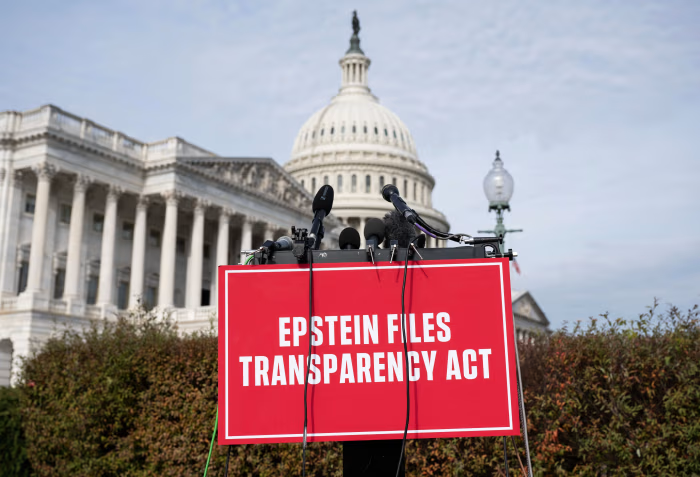
A federal judge has ordered the release of previously sealed grand jury transcripts from the 2006–2007 investigation into Jeffrey Epstein, invoking the newly passed Epstein Files Transparency Act. This marks the first substantial unsealing of documents under the Act — signaling a turning point in the long-running public and legal scrutiny into Epstein’s crimes.
What the Epstein Files Transparency Act Does
The Epstein Files Transparency Act became law on November 19, 2025, after overwhelming bipartisan approval in Congress: the House passed it 427–1, and the Senate cleared it via unanimous consent.
Under the Act, the U.S. Department of Justice (DOJ), along with the FBI and U.S. Attorneys’ Offices, must publicly release all unclassified records related to Epstein — including investigative materials, communications, flight logs, travel records, names of individuals and entities tied to Epstein, prosecutorial documents, and related files tied to prosecutions or custody matters.
There are limits, though. The law allows redaction or withholding of information that could compromise victims’ privacy, ongoing investigations, classified matters, or material that “depicts or contains child sexual abuse.” The DOJ must make the released documents searchable and downloadable. Within 15 days of publication, officials must report to Congress what was released, what was redacted or withheld, and provide a roster of all government officials and other politically exposed persons named in the records.
Judge’s Order: First Wave of Grand Jury Transcripts Released
On December 5, 2025, a U.S. District Court judge granted the DOJ’s request to unseal grand jury transcripts from the Florida federal sex-trafficking investigation into Epstein. The order cited the new law as overriding the prior secrecy typically required under grand jury rules.
These records stem from the 2006–2007 Florida grand jury probe — a long-abandoned case that never led to a full public accounting. The transcripts include testimonies, witness statements, and details from that early investigation.
This unsealing represents the first concrete action under the new transparency law. It opens the door to broader disclosures, including documents tied to subsequent criminal cases in New York involving Epstein (2019) and his associate Ghislaine Maxwell (2021). Those requests are still pending, though judges there have signaled they may rule soon.
Why This Matters: Context and Stakes
A Major Shift in Public Access
For decades, much of the documentation related to Epstein’s investigation — including how early investigations were conducted, who was named, and what prosecutors knew — has remained sealed. The new law dismantles that secrecy, potentially revealing documents that may reframe our understanding of Epstein’s network and complicity among powerful individuals.
Implications for High-Profile Associates
Because the Act mandates disclosure of names of all individuals and entities tied to Epstein’s investigations, there is real possibility that previously hidden links — including to prominent politicians, business leaders, or public figures — will surface. The transcripts and other records may document travel, communications, financial dealings, or other interactions that were never before public. Some of those individuals have historically denied wrongdoing.
Victim Privacy vs. Public Interest
The Act does include carve-outs to protect the identities and sensitive information of victims — but critics warn that even with redactions, the public release could expose survivors to renewed trauma or unwanted exposure. The tension between transparency and victim protection remains a central concern.
What’s Coming Next: December 19 Deadline
The Act gives the DOJ until December 19, 2025 — 30 days after the law was signed — to publish the documents.
The upcoming batch is expected to include:
- Grand jury transcripts from all major Epstein-related cases (Florida 2006–2007; New York 2019; Maxwell 2021).
- Flight and travel logs, manifests, immigration and customs paperwork tied to Epstein’s private aircraft and vessels.
- Internal DOJ communications: emails, memos, meeting notes relating to prosecutorial decisions, investigations that were declined or delayed.
- Records of any non-prosecution agreements, plea deals, settlements, or immunity arrangements involving Epstein, Maxwell, or their associates.
- Listings of individuals — including government officials, corporate or nonprofit executives, academics, or foreign individuals — mentioned in connection to Epstein’s criminal network or investigations.
Because of redaction provisions, some sensitive content — especially involving minors, victims, or ongoing investigations — may remain withheld. But the statute makes clear: no withholding or delay is allowed for reasons of reputational harm, embarrassment, or political sensitivity.
Reaction from Victims, Advocates, and Lawmakers
Victims and former accusers have welcomed the move, stressing that transparency is key to justice and meaningful accountability. One high-profile accuser urged that judges unseal all case materials — including victim interviews and search warrants — to reveal the full scope of what prosecutors knew and when.
At the same time, many advocates express concern about how the release is being managed. Some survivors say earlier “transparency” efforts already exposed their identities without consent, causing emotional distress and safety fears.
In Congress, lawmakers from both parties are now closely monitoring compliance with the law. They demand that any redactions be minimal and justifiable, especially given public interest in potential high-level connections.
What the Unsealed Florida Transcripts Could Reveal
Because the newly unsealed materials come from the 2006–2007 grand jury investigation — decades before many of the criminal convictions — they may provide insights into:
- Who witnesses were at the time; whom prosecutors considered or declined to pursue
- Early patterns of abuse, recruitment, and trafficking that may not have been exposed in later cases
- Flight receipts, travel itineraries, and possibly names of associates or guests who used Epstein aircraft or properties
- Internal DOJ discussions about prosecutorial decisions or declines — possibly shedding light on why earlier investigations were shelved
Even if the transcripts do not directly implicate new figures, they could offer valuable context and previously unseen documentation of Epstein’s operations.
Why This Release Could Be a Watershed Moment
The combination of new law, a court-ordered release, and a firm December 19 deadline creates a uniquely rare opportunity for public accountability. For the first time in years, individuals who were named in investigations — from financial backers to pilots, property managers, assistants, and even public officials — may be fully exposed.
Should the DOJ follow through faithfully, the public could gain access to a searchable, downloadable database containing virtually all unclassified evidence in the Epstein case. That could spur new investigations, civil lawsuits, and public reckoning.
At the same time, privacy for victims and due process for people named but not charged remain paramount. The statute tries to strike a balance — but how well that balance is maintained will shape this episode’s legacy.
What to Watch For Between Now and December 19
- Whether the DOJ posts the files publicly in one tranche or in phases
- The scale and nature of redactions, especially around victim privacy or ongoing probes
- How many — and which — individuals are named in the released records
- Whether release of these documents prompts new criminal investigations or civil suits
- How survivors and victim-advocacy groups respond once more materials become public
If properly released, the documents under the Epstein Files Transparency Act could transform public understanding of one of the most notorious criminal cases in recent American history. The next two weeks may bring revelations that reshuffle long-held narratives and raise fresh demands for accountability.
What do you think should come next? Comment below or check back for updates.